
BlackBull Markets Review: Legit Broker or Just Another Scam?


About me
Table of Contents
Here is a look at BlackBull Markets, where we examine yet another Forex/CFD broker. The company promises clients: “Trade with lightning fast execution speed” and claims to offer a great opportunity to work with a firm licensed in multiple countries while ensuring full protection of client funds. However, such slogans are common online and no longer impress traders. What really matters to them is verifying that the platform is not a scam and that users are not at risk of losing all their investments. Below, we detail what we discovered.
Does BlackBull Markets Show Any Risk Factors?
A multi-regulated broker (according to its own claims) can be appealing to many traders. However, the information provided requires careful verification.
BlackBull Markets states that it operates under:
- Black Bull Group Limited, registered in New Zealand (Company Number 5463921 and NZBN 9429041417799).
- BBG Limited, a company registered in the Seychelles under No. 857010-1, holding a Financial Services Authority (FSA) license SD045.
- Black Bull Trade Limited, another New Zealand entity (NZBN 9429049891041 and Financial Service Provider license FSP1002113).
There is more than enough information to verify, and we proceeded to collect official data.
A search in the official New Zealand business registry confirmed that Black Bull Group Limited was indeed registered in New Zealand on September 18, 2014, with the registration number and NZBN provided by the broker. The allowed activities listed include trading and brokerage services in the stock market. The registry also notes that the company owns the trading name BlackBull Markets and the website blackbull.com. The profile further mentions that the company is part of a holding named BLACK BULL GLOBAL LIMITED.

This company is also listed in the official Financial Services Providers (FSP403326) registry, which specifies licensed activities, including retail client services, derivatives trading, and Forex market services. The FSP registration dates to 2014, the same year the company was created.

Interestingly, the information provided by the broker about the second New Zealand company, Black Bull Trade Limited, was fully confirmed, both regarding registration details and FSP registration data.
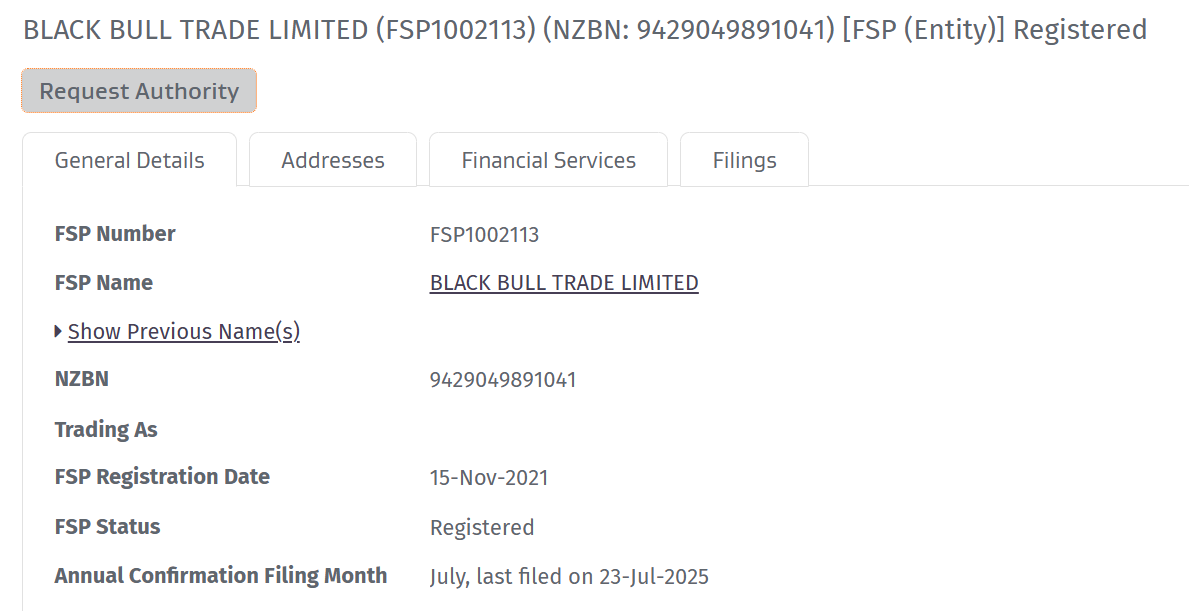

Thus, we are indeed dealing with a New Zealand broker operating under the country’s laws and licensed by the local financial regulator, FMA. At the same time, the footer of the website contains a strict statement that the broker does not accept clients from the United States or Canada, and its services are not intended for traders from the European Union, the United Kingdom, India, or other non-residents of New Zealand. In effect, the platform has limited its audience to citizens and residents of the country where it is registered.
In this context, the registration in the Seychelles and obtaining a local regulator’s license is puzzling. We, of course, verified this information. According to the Seychelles business registry, BBG Limited is indeed registered under number 857010. However, its primary activity is listed as equipment rental and leasing, which does not directly align with providing brokerage/dealer services.

Nevertheless, FSA of Seychelles data shows that the company has indeed obtained a Securities Dealer license. It uses the trade name Black Bull Markets (notably slightly different from the name used by the New Zealand companies) and operates via the website blackbull.com.

Yet, questions regarding licenses and services for traders from other countries are far from the only points of interest. We observed that the broker’s website and official records state its registration in 2014. At the same time, WHOIS data presents some rather interesting details.

We can see that the domain used by the platform was registered back in 1999. This means it belonged to someone else for 15 years, long before the companies were registered. According to snapshots from the Web Archive, it was used by a business specializing in creating characters and storylines for comics. What’s most interesting is that this company owned the domain until 2022.
So, from the date of registration in New Zealand until 2022 (when the blackbull.com domain was purchased), did the platform operate on a different website or not at all? Quite unusual for a licensed broker.

The company has been active online for a long time; at the time of writing this blackbull.com review, more than 10 years had passed since its establishment. It is therefore not surprising that there is a considerable number of publications about BlackBull Markets online. For instance, Trustpilot alone has 2,814 reviews. Impressive, isn’t it? However, the dates reveal a more complicated picture: users only began actively posting about the platform in 2020. Between March and December of that year, the broker received a significant amount of negative feedback, suggesting that the launch process was challenging, or the company didn’t know how to manage it.
Starting December 2020, however, the tone changed dramatically: the overwhelming majority of users began praising the company almost simply for its existing. Using a simple calculation, we found that, on average, traders were leaving 1.5 reviews per day during this period. It is hard to believe that so many people genuinely wanted to write positively about the firm, given how reluctant people usually are to praise companies online.
Therefore, we have little doubt: the vast majority of these reviews were likely commissioned to build the company’s reputation. Naturally, we read these posts, and what did we find? Statements like: “BlackBull has been a fantastic platform,” “This firm is simply exceptional,” “Best trading broker,” etc. Do you seriously think real traders write things like this? The project owners, however, clearly have no doubts and appear to pay well for this type of content.
The picture on specialized portals is also unusual. For example, thanks to its licenses, the company receives a fairly high score on WikiFX (6.64 out of 10).

However, the administration warns users about the high risks of working with this platform. The reason is simple: of 22 client reviews, 14 are negative. And this pattern is not limited to just this site.
Let’s Break Down the Jurisdiction
Brokers from New Zealand are generally considered an attractive choice for traders. This is due to the relatively strict requirements imposed by the local financial regulator, the Financial Markets Authority (FMA), regarding capital, management, client account handling, and other aspects. The regulator is considered reputable, although it is not classified as Tier 1.
There is, however, one issue: the FMA currently does not limit the maximum leverage available to retail traders. As a result, many New Zealand brokers offer clients leverage up to 1:500 regardless of their status, and BlackBull Markets is no exception. It is worth noting that in 2024, the regulator proposed introducing restrictions similar to those in Europe, the UK, or Australia. However, while this proposal is still under discussion, no changes have yet been implemented, so the situation remains unchanged.
What Does the Blackbull.com Website Reveal?
The developers of the company’s official website clearly wanted it to fully reflect the status of a reputable regulated broker, and to some extent, they succeeded. The structure includes a significant number of pages, which are well-optimized and load quickly. Even the thematic images are appropriate and original. The only minor drawback we noticed is the fairly common template used — one that is employed by almost every other platform operating under offshore licenses, including Seychelles. Still, this cannot be considered a significant issue.

Upon closer inspection, however, the website contains several serious shortcomings. For example:
- We were unable to find certain important company information, such as payment details or financial statements. While regulators in New Zealand and Seychelles may not require this information to be publicly available, most regulated brokers publish it to enhance their credibility. It appears the owners of this project consider such disclosure unnecessary.
- The company claims to provide traders with the most comfortable trading conditions. However, in the Markets section, there are no descriptions of each available asset group, their characteristics, or, most importantly, contract specifications. Instead, there are tables showing current prices and spreads for some instruments, which cannot be considered an adequate substitute for detailed trade characteristics. In our experience, it is rare for a licensed broker not to provide such critical information. This approach appears unusual, especially given that regulators require full disclosure so traders can review details before opening an account with a brokerage or dealing company.
- The website does contain many interesting and educational materials, including the Education Hub and numerous BlackBull Markets webinars. Online sources associate this with the 2024 purchase of a 20% stake in the company by the UK institutional broker LMAX, which has always prioritized trader education. However, the broker’s analytical content is practically non-existent. For instance, in the Research Hub, the latest market video was posted a year ago. In the news feed, new publications appear irregularly, typically every 1–2 weeks, and users wishing to access more up-to-date information are offered a paid subscription. It seems the platform owners are focused more on maximizing profits from clients than on providing a comfortable trading experience.
Overall, of course, the BlackBull Markets website is far superior to the online presence of many scam brokers. However, the impression it leaves is somewhat mixed. Some questions remain unanswered for visitors, and there could be significantly more useful material available.
Is the Broker Offering Fair or Risky Terms for Traders?
As mentioned earlier, BlackBull Markets does not provide detailed trading conditions on its website. We could not find contract specifications, so evaluation must rely on the information given in the account type descriptions.
The company offers three account types:
- ECN Standard: No minimum deposit, no trading commission, spreads start from 0.8 pips.
- ECN Prime: No minimum deposit, spreads from 0.0 pips, trading commission $3 per lot one-way ($6 round-trip).
- ECN Institutional: Minimum deposit $20,000, spreads from 0 pips, commission $2 per standard lot one-way ($4 round-trip).

All account types offer a maximum leverage of 1:500. Swap-free accounts are available, with an administrative fee of $75–150 per standard lot every 5 days. Accounts with no specified minimum deposit are recommended to be funded with at least $25 (which, incidentally, is the minimum deposit indicated in the payment methods).
Naturally, several questions arise:
- Why are swap sizes and calculation methods not provided? Without this data, it is impossible to assess the trader’s costs. It is likely that the company’s trading conditions are not as favorable as claimed.
- Does BlackBull Markets understand the level of risk for a trader using 1:500 leverage? It seems the company earns enough from spreads, commissions, and swaps, but why not ensure clients lose their deposits in the first trades? Other reasons for such high leverage are unclear. To be fair, the client cabinet does allow users to select maximum leverage, but how many beginners know the right level or can control their own greed?
- How do the conditions of the ECN Standard account correspond to real ECN network trading? The company claims to operate on the British LMAX network (as noted earlier with their partial purchase). On what basis do spreads above 0 appear in such a network? How does the platform earn revenue if it charges no commissions for these accounts? Or is it just marketing?
- Why are other trade details, such as Margin Call and Stop Out levels, not published? On what basis should a trader evaluate prospects with the broker and potential profitability?
Overall, it is impossible to properly assess the trading conditions offered by BlackBull Markets. Trader risks are high, and potential returns with extreme leverage may be significant, but even an approximate evaluation is impossible due to insufficient official data. In short, we would not open an account based on such limited information and the understanding that the broker does not intend to operate transparently.
Technical Support Analysis of BlackBull Markets
The broker has not been stingy with contact information. On the contact page, traders can find:
- A feedback form.
- A phone number with the Auckland (New Zealand) code.
- Support service email.
Additionally, the footer of the pages lists the addresses of all companies mentioned by the platform owners. There is also the option to contact support via online chat and WhatsApp. Links to social media profiles created in 2015 are also placed in the footer. Here, we see a complete set of information that could be useful to users.
Strengths and Weaknesses
- Official registration and license.
- Industry-leading trading platforms — MetaTrader, cTrader, TradingView.
- Zero entry threshold for most accounts.
- The company does not publish some important information required by regulators.
- The broker’s history contains several unresolved facts.
- Trading conditions are not fully disclosed.
- Extremely high leverage (up to 1:500) exposes traders to excessive risk.
- Many paid positive BlackBull Markets reviews appear on thematic websites.
Highlights
10+ years
License from multiple jurisdictions (New Zealand FMA and Seychelles FSA)
Native platform, MetaTrader 4/5, cTrader, TradingView
Up to 1:500
$0
Spreads from 0.0 pts, trading commission $3 per lot ler side
Email support/Phone support/Live chat support
Bank wire transfers/Credit/Debit Cards/ePayments/Crypto
A lot of fake positive reviews
FAQ
What are the drawbacks of an offshore license?
What is good about copy trading?
Is it safe to fund accounts with cryptocurrency?
Brokers under discussion



1 review about BlackBull Markets
Sort by:
-
I did not want to say anything negative about Blackbull Markets, but losing most of my deposit forced me to speak out. My account manager “helped” me by giving trading advice. Of the 7 trades I opened following his instructions, 6 had to be closed at a loss. This is the kind of “professional” guidance beginners get here. I do not recommend it!
We’ve created a glossary to help you understand key concepts. Click the button or follow the link to explore.
