
Fortissio Review: Legit Broker or Just Another Scam?


About me
Table of Contents
We present to your attention this Fortissio review, the result of our examination of a Forex/CFD broker that promises traders the reliability of an online fortress. At first glance, everything looks impressive: European registration and licensing, a modern trading platform, fast order execution, and access to more than 300 tradable assets. However, we suspect that those who believe in this seemingly perfect offer may end up disappointed. We have formed a well-founded opinion that this attractive project bears many similarities to a typical scam operation, where users are likely to lose all invested funds. Below, we take a closer look at this platform.
Does Fortissio Show Any Risk Factors?
European brokers, especially those holding official licenses issued by regulators within the European Union, are generally perceived by traders as synonymous with reliability and strong client protection. In many cases, this perception is justified. However, recent years have seen a growing number of scam projects hiding behind the credentials of legitimate companies. As a result, even brokers that appear trustworthy at first glance require careful verification.
As usual, we began our investigation by examining the company’s registration details and regulatory status. According to the official website, Fortissio is a trade name used by the Greek investment firm Vie Finance A.E.P.E.Y. S.A. The Regulations page provides the company’s registration number in the Greek Business Registry: 122000301000. The broker also states that the company operates under license No. 4/792/20.7.2017.2, issued by the Greek financial regulator, the Hellenic Capital Market Commission (HCMC).
In addition, the company claims to be authorized under the EU passporting regime by several regulators across the EU and EEA, including:
- Comisión Nacional del Mercado de Valores (CNMV, Spain), No. 4476;
- Autorité des Marchés Financiers (AMF, France);
- Finansinspektionen (FI, Sweden);
- Bundesanstalt für Finanzdienstleistungsaufsicht (BaFin, Germany), No. 156350;
- Finanstilsynet (Norway), No. FT00118482;
- Finanssivalvonta (FIN-FSA, Finland);
- Authority for the Financial Markets (AFM, Netherlands);
- Financial Supervisory Authority (FSA, Denmark).
The list certainly looks impressive. However, as mentioned earlier, without verification, these claims remain nothing more than statements. What did our investigation reveal?
The existence of Vie Finance A.E.P.E.Y. S.A. is indeed confirmed. The company is listed in the Greek Business Registry under registration number 122000301000, matching the information provided on the broker’s website. The registration record dates back to January 7, 2011.
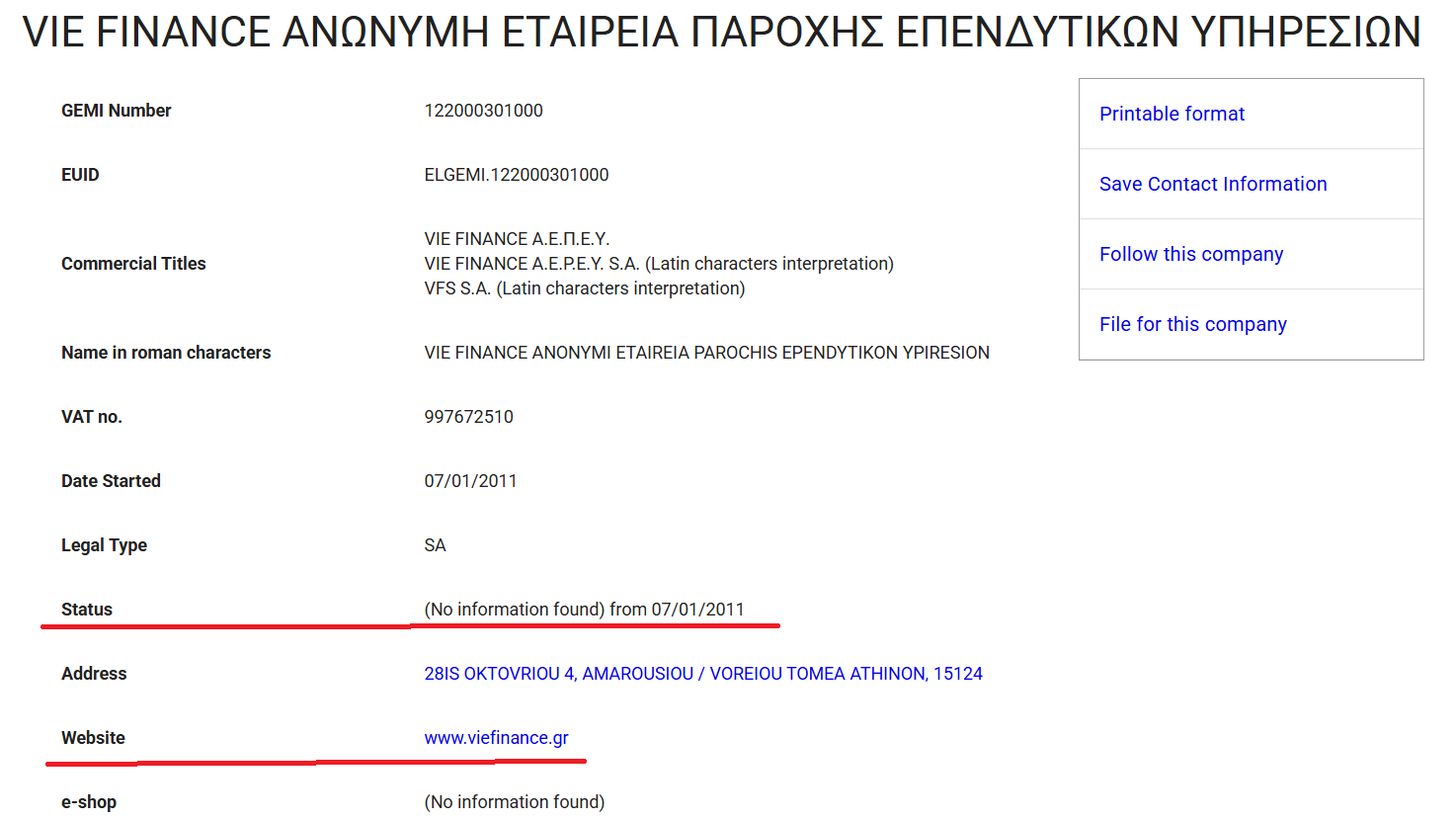
Interestingly, the registry indicates that the company uses the website address www.viefinance.gr. However, attempts to access this website were unsuccessful, as it appears to be unavailable. Another noteworthy detail is that the company’s current status is listed as unknown, despite the registration record remaining in the database.
At the very least, we can confirm that such a company was registered. It is possible that further checks will help clarify the issues identified above.
Our next step was to examine the records of the Greek financial regulator, the HCMC. This search also produced positive results: Vie Finance A.E.P.E.Y. S.A. does indeed hold a license issued by this authority. Moreover, the license authorizes the company to work with a broad range of financial instruments and to perform various investment services, from portfolio management on behalf of clients to the reception and execution of orders.

According to the regulator’s records, license No. 4/792/20-7-2017 was issued on July 20, 2017. It is at this point that we encounter a rather unusual detail that makes the otherwise perfect picture appear somewhat questionable: approximately 5.5 years passed between the company’s registration and the issuance of its license. We consider such a delay a potential red flag. It is quite unusual for an investment firm to operate for more than five years before deciding to obtain the regulatory authorization required for trading and asset management activities.
In our view, this situation more closely resembles a scenario in which the operators of a scam project, having little chance of registering a company and obtaining a license on legitimate grounds, acquire or lease a legal entity with a suitable business profile. The legitimate company passes all regulatory checks, while the fraudsters collect funds from deceived clients, naturally sharing part of the proceeds with the nominal owners. Such schemes are far from rare. In fact, many brokers whose trading names differ from the names of the legal entities listed in official registers follow a similar pattern. This is precisely the situation we observe with Fortissio and Vie Finance A.E.P.E.Y. S.A.
Let us add several more observations. First, the company is listed in the register of the European Securities and Markets Authority (ESMA). This confirms compliance with MiFID requirements and, subject to certain conditions, grants the firm the ability to operate throughout the EU and EEA.
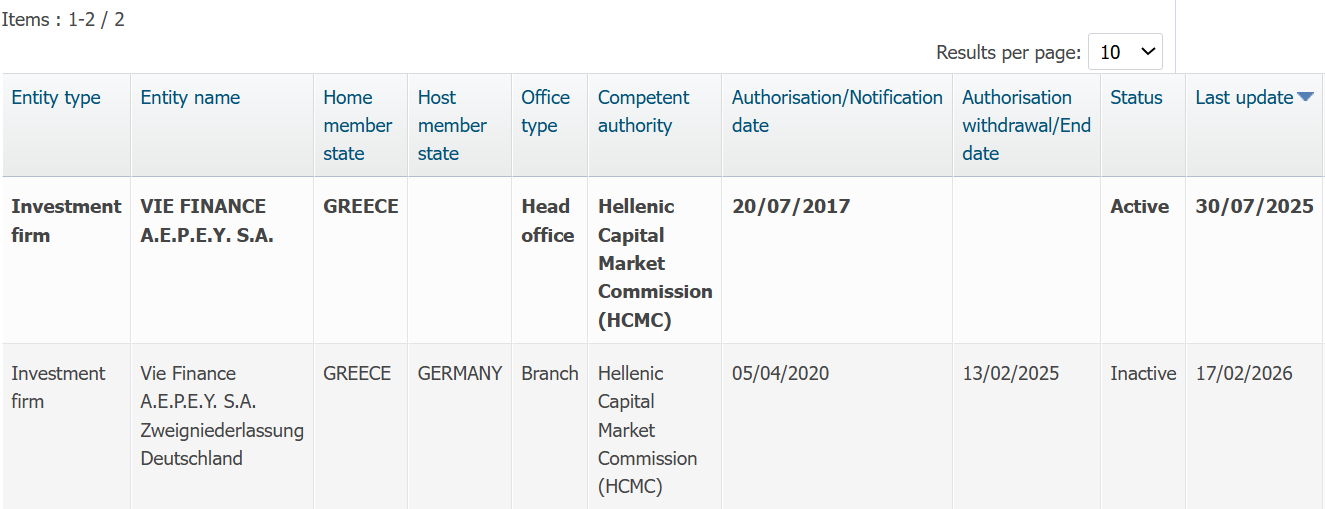
We should also mention the existence of a German subsidiary. Although this entity has not obtained a separate license from BaFin, it conducts its activities under the authorization granted by the Greek regulator. In addition, the company’s authorization with several other European regulatory bodies has been confirmed.
However, the situation is not entirely straightforward. According to WikiFX, a significant portion of the broker’s client base comes from Poland, France, and Italy. While the company is indeed authorized by the French regulator AMF, it has not secured authorization from either the Italian regulator CONSOB or the Polish regulator KNF. As a result, the KNF has repeatedly included both Fortissio and Vie Finance A.E.P.E.Y. S.A. on its Public Warning List, including in September 2024 and March 2025, due to the company’s provision of services in Poland without registration and authorization from the local regulator. In other words, it has been operating in violation of Polish financial regulations.
The project’s history also contains several unresolved issues. One of them has already been discussed: a company registered in 2011 waited approximately 5.5 years before obtaining the license required to conduct its core business activities. We have already explained why we consider this timeline highly unusual.

The history of the fortissio.com domain, which currently hosts the broker’s website, also raises questions. The domain itself is relatively old, having been registered in January 2016. This was several years after the Greek company was incorporated but before it obtained its regulatory license.
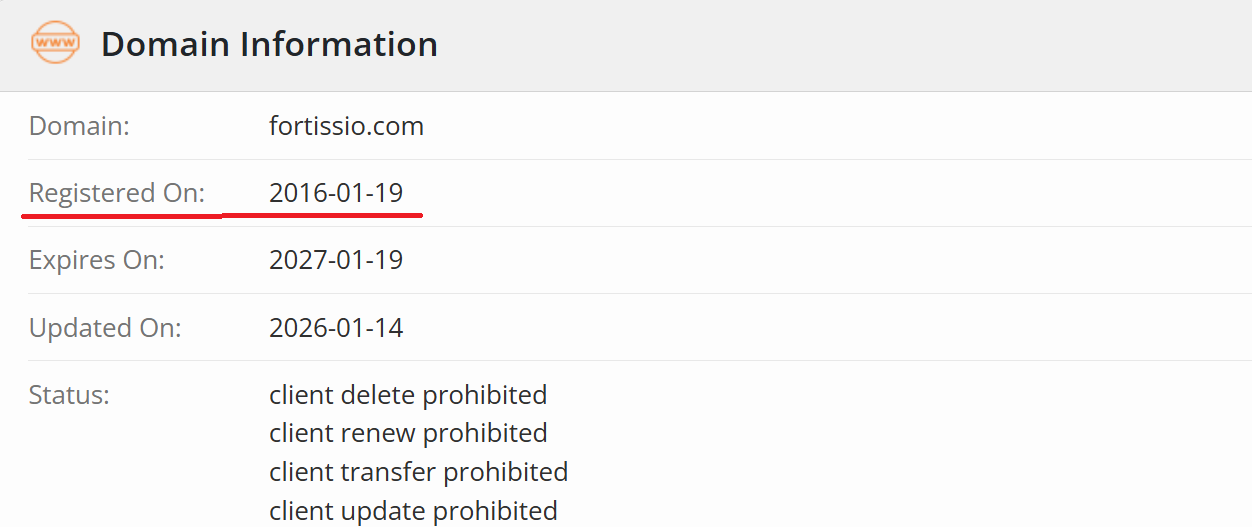
However, snapshots available through the Internet Archive indicate that there was no meaningful activity on the domain throughout 2016 or 2017. The first archived version of a fully functional website appeared only in August 2018. Therefore, it is reasonable to conclude that Fortissio effectively began its online operations in the summer of 2018.
This means the broker has been providing services for approximately eight years, which is a respectable age by industry standards. Nevertheless, we remain unconvinced that the company has operated honestly throughout that period.
These concerns are reinforced by user feedback found online. For example, the first review of fortissio.com on Trustpilot was published on November 4, 2020. Since then, the platform has accumulated only around 90 reviews. When a broker receives, on average, roughly one review per month, it is difficult to describe it as a particularly popular or successful company in terms of client acquisition.
The situation becomes even more troubling when approximately 72% of those reviews are negative. Such a ratio naturally raises doubts about the broker’s integrity. Moreover, the complaints are remarkably similar. Users frequently report difficulties withdrawing funds. In some cases, accounts are allegedly blocked, while in others, withdrawal requests are marked as “completed” despite clients claiming that no funds were actually received. Many reviewers also complain about the lack of competent assistance from customer support.
The concerns expressed by dissatisfied clients are echoed by experts from specialized trading websites. For instance, WikiFX assigned the broker a rating of just 1.58 out of 10 despite the company’s European regulatory license. Evidently, industry observers are also skeptical about whether the broker obtained its regulatory status entirely through its own efforts and without relying on questionable arrangements.
Let’s Break Down the Jurisdiction
Let us take a closer look at the company’s Greek registration and its license from the Hellenic Capital Market Commission (HCMC). The HCMC is Greece’s official financial regulator responsible for supervising the country’s financial markets. It is important to emphasize that the commission operates fully within the legal framework of the European Union and follows the strict requirements established by the MiFID directives.
As a result, a broker holding an HCMC license gains the right, subject to certain conditions, to offer its services throughout the European Union and the European Economic Area (EU and EEA). For clients, this provides several important safeguards, including:
- Financial stability and reliability. The regulator requires licensed firms to maintain a minimum level of capital and establish financial reserves. This reduces the risk of a company operating solely on client deposits without having its own financial buffer.
- Segregated storage of client assets. Regulations require client funds to be held in dedicated accounts completely separate from the company’s operational accounts. In theory, this prevents the broker from using client money for its own purposes or to cover corporate losses, even if the firm experiences financial difficulties.
- Client protection through compensation schemes. In the event of a broker’s insolvency or license revocation, traders whose broker participates in an approved compensation mechanism may be entitled to receive reimbursement for losses from the relevant fund.
- High level of transparency. Licensed companies are expected to publish financial statements regularly, provide clients with comprehensive information about risks, and comply with strict advertising standards designed to prevent misleading claims and manipulative practices.
- Uniform trading standards. Within the European regulatory framework, brokers must comply with leverage restrictions, investor-protection requirements, and limitations on aggressive marketing techniques such as no-deposit bonuses that may encourage irresponsible trading behavior.
Of course, an important clarification should be made. The HCMC is not generally regarded as one of the most stringent or influential regulators in Europe. In terms of supervisory rigor, it is often considered less demanding than authorities such as the UK’s FCA or Germany’s BaFin. Nevertheless, it possesses the core powers and regulatory tools typically associated with European financial watchdogs.
Let us now compare these safeguards with the information the company publicly provides about itself. After carefully reviewing the available materials, several questions arise. How transparent is the broker’s financial reporting? Does the platform disclose the banks where client funds are supposedly held in segregated accounts? Does the website provide details of independent organizations or responsible individuals whom clients can contact in the event of a dispute?
We were unable to find such information. At the very least, this appears questionable. It naturally raises the issue of whether the platform is actually complying with all the obligations associated with holding a Greek investment license.
The only reference we were able to locate concerns the Syneggiitiko compensation fund. Vie Finance A.E.P.E.Y. S.A. is indeed listed among its members. However, this organization is private and is not part of any government-backed compensation program. Furthermore, the company’s profile on the fund’s website describes it as a REIT (Real Estate Investment Trust).
Under these circumstances, we are not convinced that clients of the broker would be entitled to receive any meaningful compensation through this arrangement. What we can say with confidence is that the information presented creates the impression that users may be receiving a misleading picture of the actual level of protection available to them.
What Does the Fortissio.com Website Reveal?
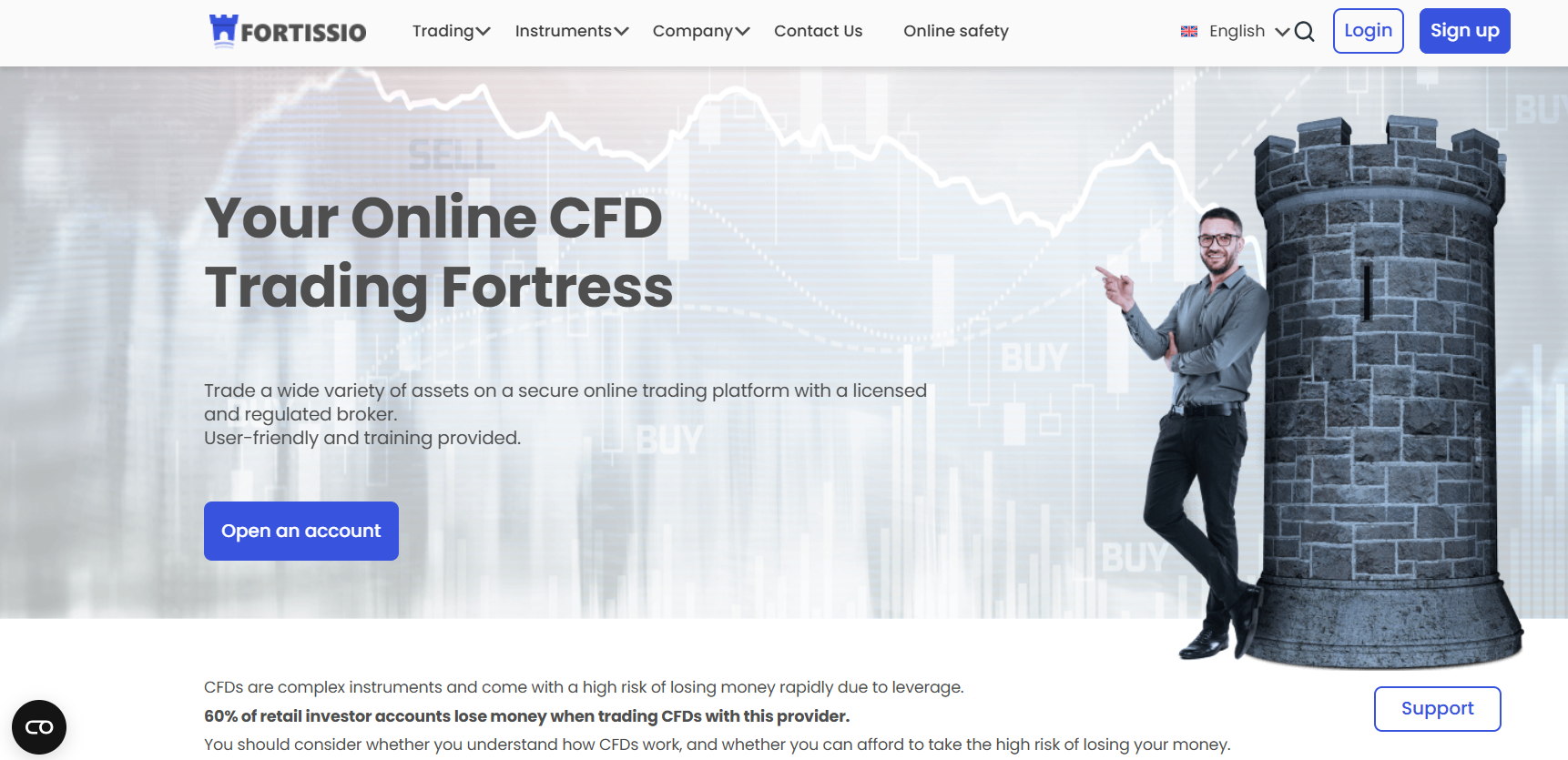
At first glance, the company’s website looks quite decent. The page structure and navigation are logical and user-friendly. It is also worth noting that the content loads quickly and without noticeable delays, suggesting that the site has been properly optimized.
As for the design, Fortissio has chosen a classic layout with a bright white background dominating most information blocks. This approach generally remains attractive to users. The designers have also made appropriate use of thematic images while largely avoiding excessive animations that often distract visitors. Overall, the website appears to be a professionally designed resource rather than a flashy advertising presentation.
The content quality is reasonably good in some areas as well. For example, the pages within the Instruments section provide fairly detailed descriptions of the available markets, including trading specifics and illustrative examples. Traders may also be attracted by the advertised Autochartist tools, autonomous price charts, an economic calendar, and a news feed.
However, there is a problem. Instead of actual Autochartist signals and live charts, the website only provides descriptions of these features. Moreover, the Investing.com economic calendar widget and the news feed fail to load any content. As a result, visitors are presented with placeholders rather than functioning analytical tools.
Similar issues can be found throughout the website. For instance, the Company section contains legal documents governing the relationship between the broker and its clients, information about the broker itself, and details regarding regulatory oversight. At the same time, as we have already mentioned, some of the most important information about the company is noticeably absent.
The Fortissio registration process is also quite remarkable. In accordance with requirements commonly imposed by European regulators, new clients are asked to provide all standard personal information, including their full name, contact details, date of birth, and residential address. The most interesting part comes afterward. Verification of the provided information is not required during the registration process, yet users cannot complete account creation without first funding their account.
We have not encountered such an openly questionable approach for quite some time. Even many fraudulent projects have largely abandoned practices of this kind. In our view, this should be regarded as a significant red flag.
Is the Broker Offering Fair or Risky Terms for Traders?
One aspect of Fortissio that may initially appeal to traders is the availability of detailed trading conditions. However, let us examine them step by step.
The broker offers clients no fewer than 11 different account types. The primary differences between them are the amount of equity available for withdrawal and the discounts applied to spreads and swap fees.
| Account type | Equity from…, USD | Discount, % |
| Starter | 200 | 0 |
| Explorer | 1,000 | 5 |
| Champion | 5,000 | 10 |
| Elite | 10,000 | 15 |
| Luxury | 15,000 | 20 |
| VIP | 30,000 | 25 |
| Prestige | 50,000 | 30 |
| Siperior | 75,000 | 35 |
| Infinity | 100,000 | 40 |
| Royal | 150,000 | 50 |
| Expert | 200,000 | 60 |
The broker’s base spreads can be found either in a separate PDF document or on the “Product Sheet & Costs, Trading Conditions” page within the Trading section of the website. The same page also contains the base swap rates.
The page is quite informative, but we still have several concerns regarding its contents:
- The table indicates a maximum leverage of 1:20 for retail clients, while the margin requirement is listed as 3.33%, which actually corresponds to a leverage of 1:30. Does the broker’s staff simply not know how to calculate leverage ratios? At the same time, everything appears consistent for professional traders, where leverage of 1:200 correctly corresponds to a 0.5% margin requirement.
- The base spread for the EUR/USD pair is listed at 4 pips. This figure is exceptionally high by modern industry standards. Even after applying the maximum 60% discount available to traders with account balances of at least $200,000, the spread would still be 1.6 pips—at least twice as high as the spreads offered by most licensed brokers.
What conclusions can be drawn from this? The leverage limits fully comply with ESMA requirements. However, the spreads reveal what appears to be excessive greed on the broker’s part. This impression is reinforced by the questionable practice of offering progressively better trading conditions only to clients who deposit larger amounts of money.
It is also important to note that the published trading conditions do not constitute a complete contract specification. For example, we were unable to find information regarding Margin Call and Stop Out levels or the minimum distance requirements for pending orders. Frankly speaking, this hardly qualifies as full disclosure of trading conditions and, in our opinion, falls short of what a regulator would normally expect from a licensed broker.
Technical Support Analysis of Fortissio
The broker certainly does not appear to have been stingy when it comes to communication channels. The website provides users with:
- A contact form.
- A mailing address for an office located in Marousi, Greece (one of the suburbs within the Athens metropolitan area).
- A landline telephone number with an Athens area code.
- Email addresses for customer support and several company departments.
In addition, the website features an online chat system with an AI assistant and the option to connect directly with a human operator.
Overall, this creates a fairly professional impression. However, the listed telephone number can be clearly identified as belonging to a VoIP service pool. This raises questions about whether the company actually maintains a physical office, especially considering that the published office address does not match the registered company address.
There is another unusual detail worth mentioning. The website provides no links to social media profiles. We find it difficult to believe that the project’s team has not had time to create social media pages, groups, or channels during nearly nine years of operation.
We also know how important social media presence is for legitimate brokers seeking to attract retail clients and maintain public communication. Why Fortissio has chosen to ignore these opportunities remains difficult for us to understand.
Strengths and Weaknesses
- The company is officially registered in Greece and holds a license issued by the local financial regulator.
- The minimum deposit requirement is $200, making the broker accessible to most European retail traders.
- The legitimacy of how the broker obtained its Greek license raises questions.
- Some of the information published on the official website appears to be inaccurate or misleading.
- Trading conditions are not fully disclosed, and the published terms compare unfavorably with those offered by competitors.
- It is impossible to complete the registration process without making a deposit.
- User reviews and expert opinions available online are predominantly negative.
Highlights
5+ years
Webtrader
Up to 1:200
200 USD
High
Email support/ Phone support/ Live chat support
Bank wire/ Credit/Debit cards
Negative reviews
FAQ
Why does the Polish KNF consider the broker's activities illegal?
Why does the company offer such low leverage?
My withdrawal request has not been processed. Where can I seek help?
Brokers under discussion



1 review about Fortissio
Sort by:
-
My short experience with Fortissio can hardly be described as positive. The scammers first gained my trust and then almost completely wiped out my rather substantial $11,000 deposit. As far as I understand, there is probably no point in trying to fight these anonymous fraudsters on my own.
We’ve created a glossary to help you understand key concepts. Click the button or follow the link to explore.
