
FXNX Review: Legit Broker or Just Another Scam?


About me
Table of Contents
Among Forex/CFD brokers, there are quite a few that obtain official registration and licenses, yet operate like typical scam projects when dealing with clients. Today, in our FXNX review, we are looking at one such platform, which modestly describes itself as “Next Generation Forex Trading.” At the same time, it cannot seem to decide how many countries it covers (45, 150, or 180) or how many clients it has attracted (8,500, 10,000, or 20,000+). We believe you already understand: this is the “next generation” of fraudulent products, where users’ money is instantly turned into company funds. Below, we will reveal everything the scammers chose to keep silent about.
Does FXNX Show Any Risk Factors?
What should a trader consider when choosing a broker? The list is quite extensive, but the key points are relatively few:
- The presence of official registration and a license, and whether operating under such a license is legal in the user’s jurisdiction.
- Trading conditions — whether they allow for consistent long-term profitability and how significant the risks are.
- Communication channels with customer support and whether it can promptly resolve emerging issues.
- The company’s reputation online, including complaints from both former and current clients.
Naturally, the most important aspect is the official information about the company. This is where we usually begin our analysis of any platform, and we did not deviate from this approach in our fxnx.com review.
We studied the homepage and the Regulation page. The information on both is largely duplicated. The broker claims to be owned by FXNX Global Markets Ltd, a company registered in Saint Lucia. Verification shows that a record of such a company, with IBC (International Business Company) status, is indeed listed in the registry of this Caribbean jurisdiction.
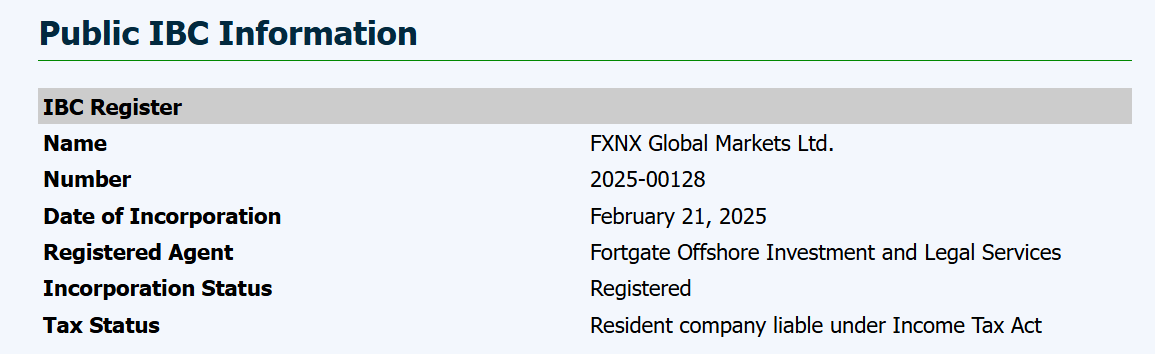

The solution for the project’s creators was a relatively inexpensive license from the financial regulator MISA, issued on the island of Mwali (Mohéli), Union of Comoros. References to operating under this regulator appear on many pages of the FXNX website. Verification confirms that both the registration on this autonomous island and the license do exist.
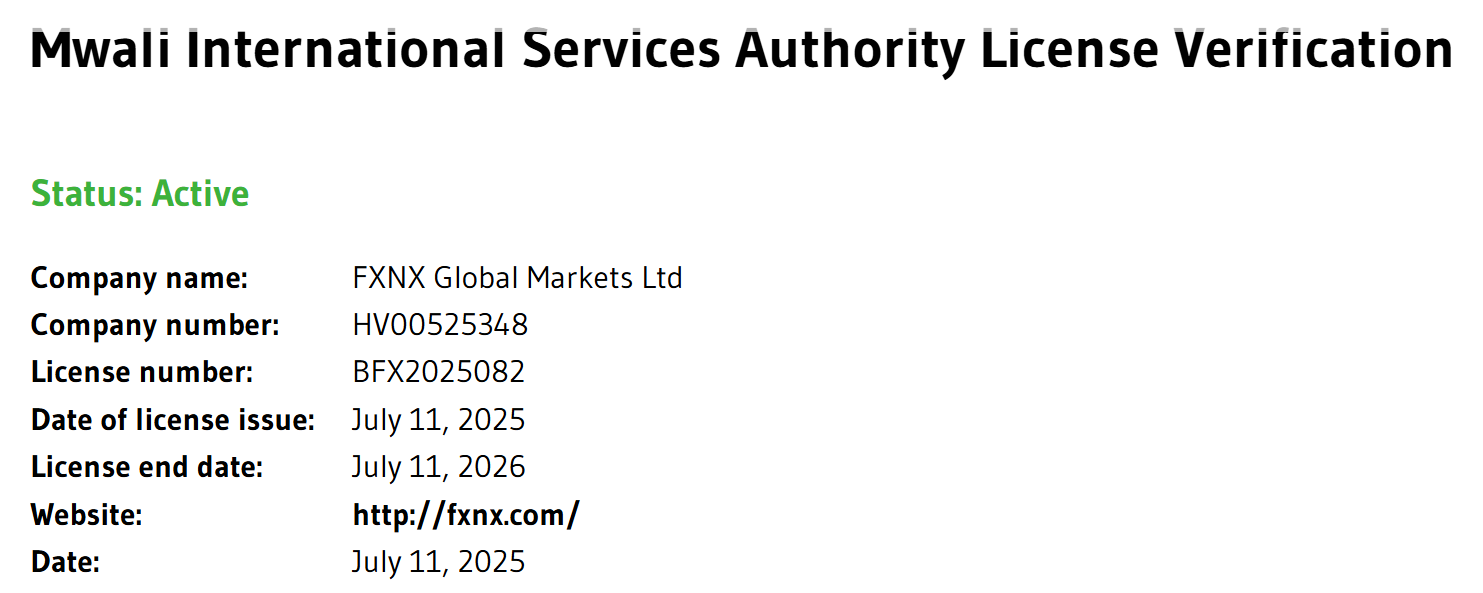
We also observe that both the registration and license numbers match those provided by the company, along with confirmation that the domain fxnx.com belongs to the firm. We noted that the authorization document was issued on July 11, 2025 — four months after the company’s registration in Saint Lucia. This raises an important question: was the broker providing services during those months without a license?

We attempted to find an answer using the WHOIS service. The results turned out to be quite interesting.
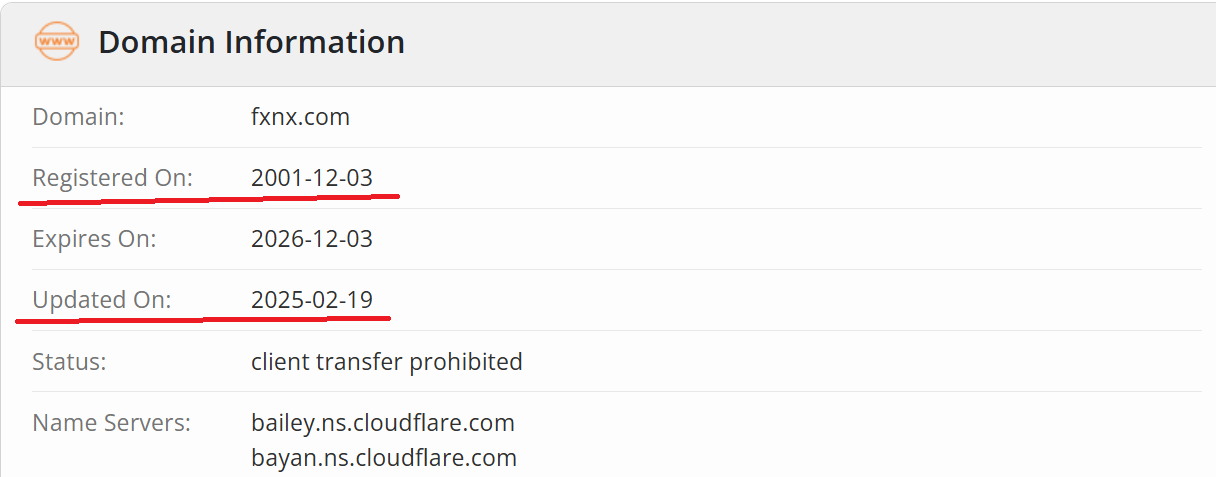
As we can see, the domain fxnx.com was registered quite a long time ago, back in 2001. However, snapshots from the Web Archive show that the company only acquired it at the end of 2025 and immediately began developing its official website. Based on the date of the last significant update, the site was launched on February 19, 2025. In fact, our assumption that the broker started operating without a license has been confirmed.
Apparently, even after more than a year of operation, FXNX has failed to gain real popularity among traders. This becomes evident when looking at online reviews. For example, there are only 6 comments on Trustpilot, with the first one published on September 22, 2025. It is obviously that after obtaining a license, the company made an effort to build a positive reputation. This is reflected in uniformly high ratings and equally meaningless texts. All of them appear to be either commissioned or written by company employees.
Surprisingly, the platform has a relatively high score on WikiFX — 5.58 out of 10. Interestingly, there are quite a few comments about FXNX on this portal (51), and most of them (43) are positive. We reviewed them carefully and concluded that these, too, are likely commissioned by the broker’s administration. The only posts supported by real screenshots of user accounts and correspondence with support — just two — are negative. The rest follow a familiar pattern: short and lacking any evidence.
Let’s Break Down the Jurisdiction
As we can see, FXNX claims (and this information has been confirmed) registration in Saint Lucia and Mwali (Mohéli), Union of Comoros. In addition, it has obtained a license from the Mwali International Services Authority (MISA), a financial regulator on the autonomous island. Based on these facts, the broker claims to hold two licenses and to be fully regulated. However, these statements are nothing more than an attempt to mislead potential clients:
- We can see that in Saint Lucia the company is registered as an IBC (International Business Company). This is an official offshore status that exempts such companies from corporate tax if income is generated outside the country and the Eastern Caribbean region. To provide brokerage/dealer services within the country or region, such companies must obtain a license on general terms from the local financial regulator — the Financial Services Regulatory Authority (FSRA) — in cooperation with the Eastern Caribbean Central Bank (ECCB). If the broker operates exclusively internationally, no license is required. Accordingly, there is no real regulation of the platform’s activities, nor are there any binding requirements or oversight.
- According to statements by the financial regulator of the Union of Comoros — the Central Bank of Comoros (BCC) — the Mwali International Services Authority is a self-proclaimed organization that has unlawfully assumed the authority to issue licenses to financial service providers. Therefore, such documents are legally void. Naturally, they are not recognized by official authorities in other countries, experts, or the broader trading and investment community. For example, it is enough to look at the same WikiFX rating, where the MISA license is scored at 0.0 points.
At the same time, we can see how the project’s owners attempt to promote the narrative that their operations are legitimate even within the European Union. They claim compliance with GDPR in the collection, storage, and use of personal data, and even state participation in a deposit compensation scheme with payouts of up to €20,000 for affected traders. Naturally, we carefully reviewed the Privacy Policy and can say that it has virtually nothing to do with actual GDPR requirements (aside from a superficial mention). There is also no documentary evidence confirming participation in any compensation schemes.
At this point, it is important to remind traders that even if the broker is not authorized to operate in their country, they may still be able to register, open accounts, and trade. However, they do so entirely at their own risk — their rights and interests are not protected by any regulatory body. Moreover, the company may refuse service at any time, and there is no guarantee that client funds will be returned.
What Does the Fxnx.com Website Reveal?
To be honest, the design of the broker’s official website left us disappointed. Some users might appreciate the abundance of colors, but in our view, it would be more suitable for an online casino or a retail e-commerce site rather than for a reputable brokerage platform. However, it seems that the developers fulfilled their actual task quite effectively: to draw attention to certain labels and interface elements while diverting it away from the content of numerous sections that are supposed to contain key information about the company’s operations. In that respect, they succeeded remarkably well.
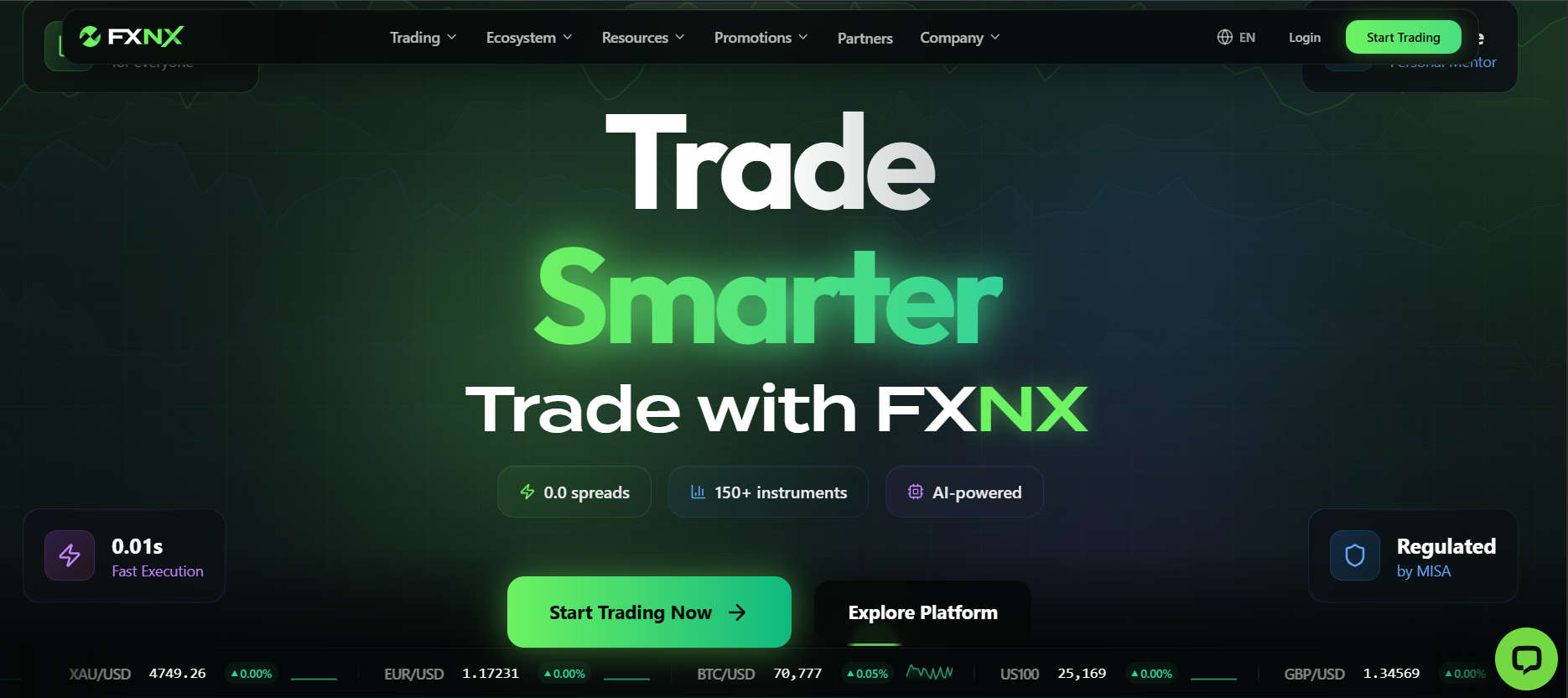
The owners of FXNX clearly have something to distract users from on their website. Just take a look:
- On the homepage, in two adjacent info boxes, we see offers of 150+ and 500+ trading instruments.
- A similarly revealing situation appears with the number of active clients. We have seen figures of 8,500, while the homepage (again, in neighboring boxes) mentions 10,000+ and 20,000+.
- It is no longer surprising to see conflicting numbers regarding the number of countries covered by the broker’s services: 45, 50+, 150, or even 180.
- There is little to add when the About page mentions three languages, while we counted five in the site menu.
We could also comment on the informational value of the website pages. However, we felt that doing so would not improve the overall impression — if anything, it might make it worse. Instead, we decided to examine the registration process and the user dashboard.
Here, too, we were disappointed. First, creating an account requires only a very basic registration form: full name, phone number, email, and password. After submitting the form and confirming the email, the user gains access to all features except withdrawals. Notably, the user profile does not require additional information such as an address. This raises an obvious question: what exactly does the company verify under its stated KYC procedures? And can we even speak of KYC at all when the only personal data collected is a full name?
It is unclear why the broker complicates matters for both itself and its clients with a verification process that makes little sense given such an approach to KYC/AML. One can only speculate how the personal data and document copies obtained by potential fraudsters might be used.
Is the Broker Offering Fair or Risky Terms for Traders?
FXNX has chosen not to fully disclose its trading conditions to visitors of its official website. In particular, there is no contract specification document — one of the most essential documents for any broker. Instead, the platform’s owners provide fragmented information that can be interpreted as favorable offers for clients. Specifically, they promote a single trading account with supposedly identical conditions for all traders.

On the page presenting this account type, we were able to find the following details:
- Minimum deposit — $100.
- Maximum leverage — 1:500.
- Tight spreads from 0.0 pips.
- Trading commission — from $1 per lot per side (from $2 round turn).
In addition, the broker promises fast order execution — under 100 milliseconds.
At first glance, this looks quite attractive. However, in practice, it raises many doubts. For example, a $2 commission for a trade volume of 1 standard lot ($100,000) amounts to just 0.002%. As a rule, even stock brokers do not offer such low fees. At the same time, judging by current asset prices shown on the Instruments page in the Trading section, spreads are indeed extremely tight — on calm markets, EUR/USD spreads appear to be around 0.1–0.2 pips. This raises a logical question: how exactly does the broker plan to generate profit? It is difficult to believe in such altruism, just as it is hard to assume the company is willing to operate at a loss simply to provide traders with the best conditions.
Such attractive offers can partly be explained by the extremely high leverage of 1:500. Although it varies across asset classes (for example, only 1:20 for stocks), it still remains significantly higher than what is allowed by top-tier regulators. As we have mentioned before, this leads to a multiple increase in trader risk. It is worth recalling statistics showing that even under conditions approved by the European Securities and Markets Authority, 75–80% of retail traders lose their deposits. One can only imagine how much higher this percentage becomes when the risks of losing trades increase several times over. We can say with confidence that most inexperienced users are likely to lose their funds in their very first trades, with a probability close to 100%.
Since the broker acts as the sole counterparty to client trades, all trader losses effectively become the broker’s direct profit. Naturally, when expecting to earn hundreds of dollars from a few losing trades, there is little incentive to focus on earning $1–2 from spreads. On the contrary, it makes sense to minimize visible trading costs in order to attract more users looking for “cheap” trading and increase deposit inflows.
It should also be added that FXNX is not entirely transparent even here. For example, it does not disclose swap rates, without which it is impossible to calculate total trading costs. It also omits key parameters such as pending order distances and Margin Call/Stop Out levels, making it impossible to objectively assess risks. As a result, the broker’s “super favorable” trading conditions appear to be nothing more than a trap for those seeking quick and substantial profits. In reality, what they are most likely to achieve is fast and significant losses.
Technical Support Analysis of FXNX
To its credit, the company has taken a comprehensive approach to client communication channels. Traders are offered multiple ways to get in touch:
- Contact form.
- Email (with a response promised within 24 hours).
- A UK-based phone number.
- Live chat on the website.
- A Telegram chatbot.
As we can see, FXNX provides options both for quick issue resolution and for handling more complex inquiries that do not require immediate attention.
The homepage also contains links to the company’s social media profiles. However, these do not inspire confidence. For example, the YouTube channel was created only in December 2025 and has gained just 29 subscribers over four months. Meanwhile, the account on X (Twitter) has not posted anything since April 2025. This serves as a clear illustration of the low level of client interest in the project and its inability to engage with its target audience.
Strengths and Weaknesses
- The broker is officially registered in two jurisdictions and even holds a license in one of them.
- Only $100 is required to start trading, making it accessible even for beginner traders.
- The MISA license is practically not recognized, which raises serious doubts about the legality of the services provided.
- It is difficult to trust a broker that publishes inconsistent and unreliable information on its website and cannot even keep its own statistics straight.
- Trader risks with leverage up to 1:500 are excessive.
- Trading conditions are not fully disclosed.
- The overwhelming majority of reviews are positive and appear to be clearly commissioned.
Highlights
1+ year
License from a questionable jurisdiction (MISA No. BFX2025082)
MetaTrader5
Up to 1:500
$50
Medium
Email support/ Phone support/ Live chat support
Crypto
Fake positive reviews
FAQ
Can a company with an MISA license offer the MetaTrader 5 platform?
Why do you consider the company’s profit to be minimal?
How important is the status of a broker’s license?
Brokers under discussion



1 review about FXNX
Sort by:
-
Please be careful! Do not cooperate with FXNX if you want to avoid problems. Unfortunately, when I started working with this intermediary, there were no reviews about it yet. This dishonest broker initially assigned me a “great” manager (at least, that’s what I thought at the time). He helped me pass verification, fund my account, and understand the platform. However, I couldn’t figure out how to withdraw funds on my own. When I asked him for help, there were at first “technical issues,” and then he simply stopped answering my calls. No one responds to my emails, and the phone lines have gone silent… It has been a month now that I’ve been trying to reach them, but all in vain. I gave these scammers a significant amount of money, and it seems I’ve lost it forever.
We’ve created a glossary to help you understand key concepts. Click the button or follow the link to explore.
