
Regulus Liquidity Review: Legit Broker or Just Another Scam?


About me
Table of Contents
Our Regulus Liquidity review covers a Forex/CFD broker that tries to impress traders right from the homepage banner with sophisticated talk about institutional liquidity. It is followed by offers that, according to the company, are simply impossible to refuse: 1,200+ trading instruments, spreads from 0.0 pips, and full regulation by the FSC of Mauritius. Impressed? So were we, even though we are far from beginners. However, we decided to find out whether the platform promising institutional-grade trading conditions is actually delivering on those claims, or whether it is simply another scam. Here’s everything we discovered.
Does Regulus Liquidity Show Any Risk Factors?
Everyone knows that only regulated brokers deserve trust. However, simply claiming that a company operates under the license of a particular regulator cannot be considered sufficient proof of reliability. A broker must provide documentary evidence of its official registration and regulatory authorization. In addition, it is important to consider whether the company has been operating long enough to establish a positive reputation. These are the first factors we examine in every review, and our regulus.org review was no exception.
To be fair, the broker did more than make empty claims. In the footer of its website, it provides information about its registration in the Republic of Mauritius and states that it holds a license issued by the local regulator, the FSC. We decided to verify whether this information was accurate by checking the publicly available official registers.
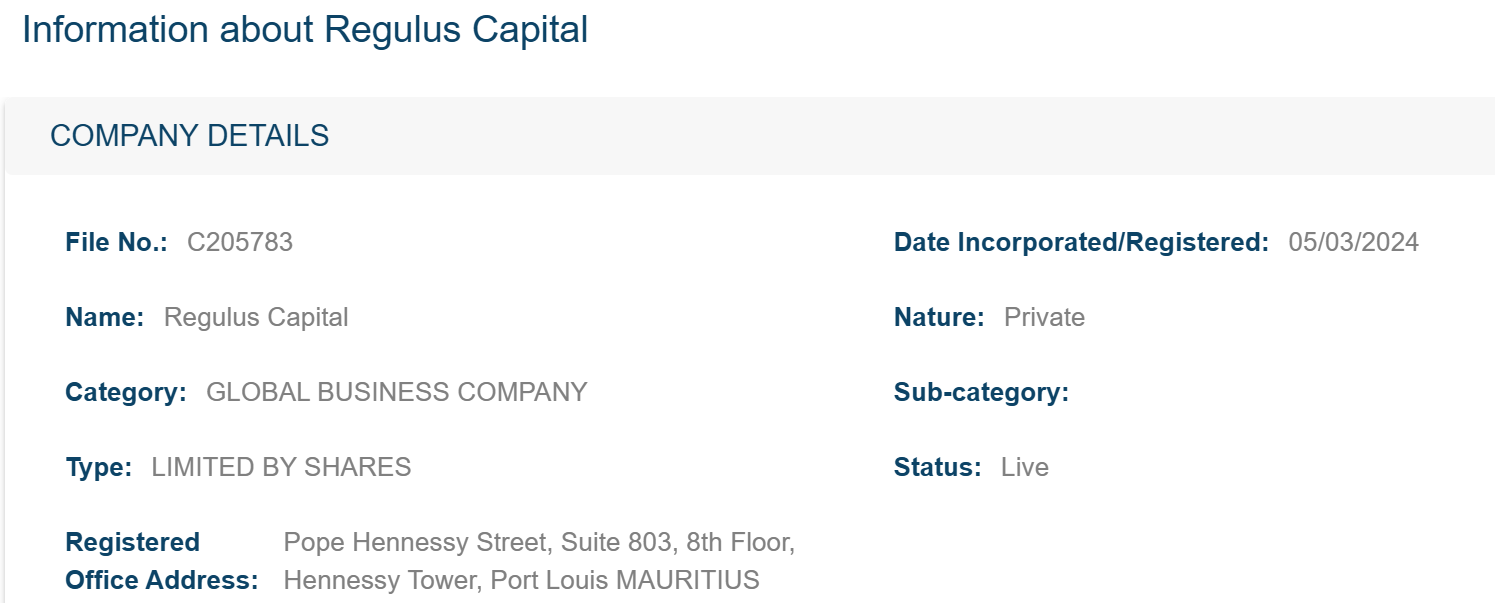
The business register does contain information about a company called Regulus Capital, whose registration number (C205783) matches the one displayed on the broker’s website. The company was incorporated on March 5, 2024, and remains active. One detail that raises some concern is the difference between the broker’s name and the registered company name. For now, however, we will assume that the website uses a trading name and simply failed to disclose the official legal entity name.
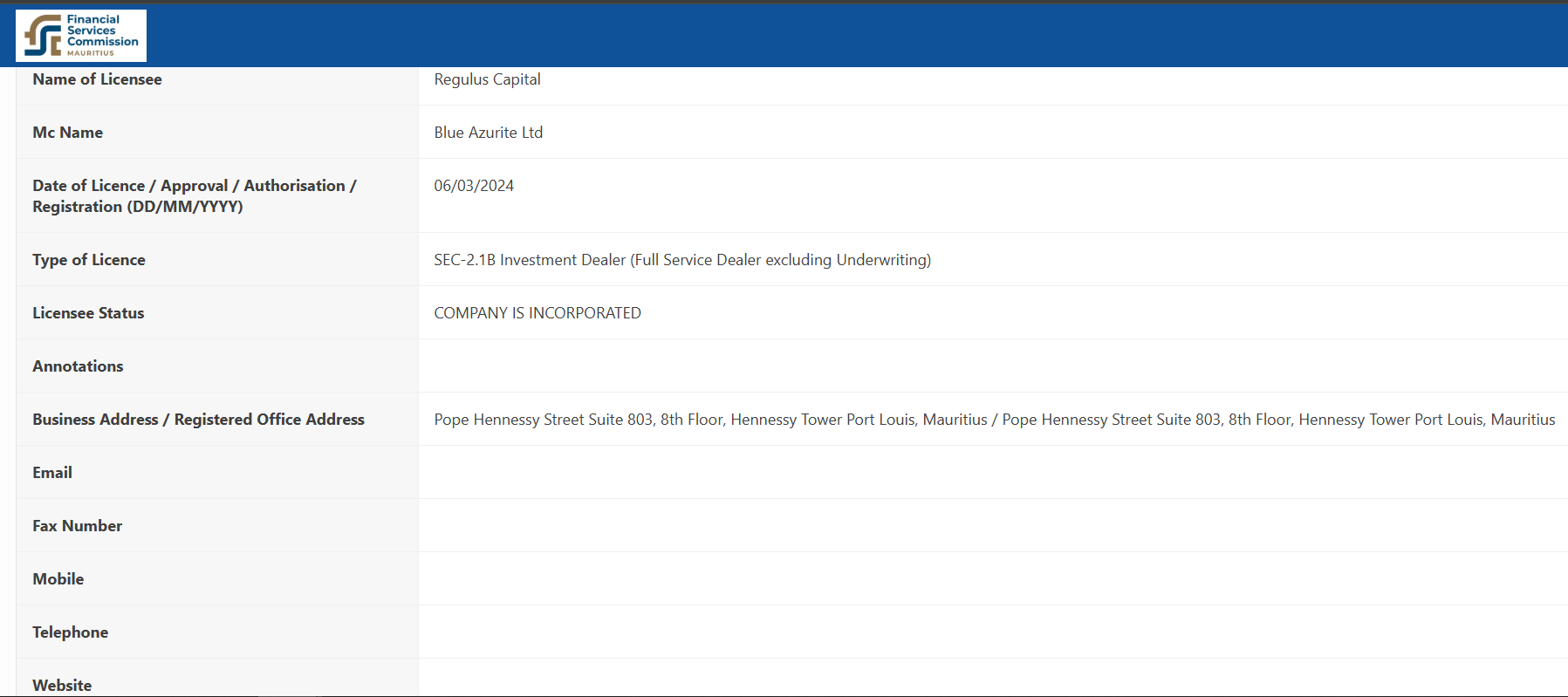
As the FSC of Mauritius register confirms, Regulus Capital was granted an Investment Dealer (Full Service Dealer, excluding underwriting) license on March 6, 2024. Furthermore, the registered address — which also serves as the company’s office address — matches the address published on the broker’s website.
Unfortunately, the licensing information does not resolve the discrepancy between the broker’s name and the legal entity’s name. The reason is that the FSC’s online register traditionally does not display either the license holder’s trading name or the website through which the company conducts its business.

The most interesting point is that, for traders from most other countries who wish to trade on this platform, it makes little practical difference which of these two hypotheses is correct. In reality, a license issued by the FSC of Mauritius authorizes brokerage/dealer activities only in jurisdictions where there is no requirement to establish a local legal entity or obtain authorization from the local financial regulator. Clients from other jurisdictions may only be served under the Reverse Solicitation principle — that is, when the client independently contacts the company, opens and funds an account, and trades without being targeted by the broker’s marketing in that jurisdiction, provided such an arrangement is not prohibited by local law.
At the same time, traders cannot rely on the investor protection measures available in their country of residence, such as compensation schemes, assistance from the local financial regulator, or support from a financial ombudsman. In such cases, the FSC license offers them no practical protection. In essence, the license merely confirms that the company met the regulator’s licensing requirements and may therefore be considered more reliable than an unregulated firm.
One of the key factors for any trader is how long a broker has been operating. Unfortunately, Regulus Liquidity does not disclose its history. The only information we found in public sources concerns the company’s incorporation and licensing dates — both in early March 2024. We therefore checked the domain registration records through the WHOIS service.
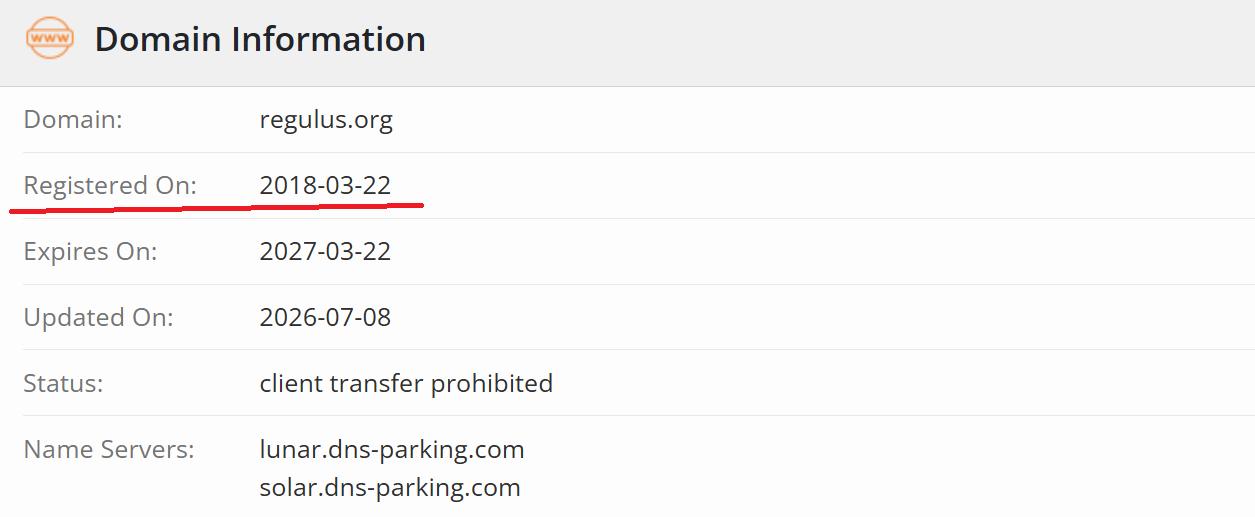
The WHOIS data shows that the regulus.org domain was registered more than eight years ago, on March 22, 2018. In fact, it is almost six years older than the current company. Could the broker have been using the domain before the company’s registration? Possibly, but this is easy to verify using snapshots from the Web Archive. It turns out that before 2024 there was no broker’s website on this domain at all, and the domain belonged to a different owner. We were unable to determine exactly when it was acquired for this project, but we clearly found that the broker’s website first appeared in archived snapshots only in early 2026.
This aligns perfectly with the publication history we found online. The first regulus.org review on Trustpilot was posted on March 10, 2026, followed by WikiFX on March 11, 2026, and FastBull on April 2, 2026. This would suggest that, despite obtaining its license in 2024, the company spent nearly two years neither providing online brokerage services nor even developing its website, only becoming active online afterward.
In our opinion, that scenario is highly implausible. We are inclined to return to our earlier assumption and expand upon it: the broker was likely launched in early 2026 and is using the details of the Mauritian company to create the appearance of legitimacy without authorization. Another possible explanation is that the broker was established in early 2026 and either acquired or leases the Mauritian company from its actual owners, allowing it to use the company’s information lawfully. Regardless of which scenario is true, neither inspires confidence. Attempts to circumvent legal requirements are characteristic of fraudulent operations whose sole objective is to obtain traders’ money.
There is another noteworthy fact. Comments about the company’s activities — although relatively few in number — appeared almost simultaneously on several well-known websites, including industry-specific platforms. Notably, most of their authors gave the broker very high ratings. This leads us to the same conclusion we often reach: the owners of the broker appear willing to spend heavily on building its reputation.

Nevertheless, the broker’s rating on WikiFX is relatively high (4.74 out of 10, which is higher than that of many other brokers), and it does not even display the usual warning about offshore regulation. However, as we know, the automated data collection and processing used by rating platforms does not always produce reliable results.
Let’s Break Down the Jurisdiction
The Financial Services Commission (FSC) of Mauritius is no longer regarded by regulators as a classic “cheap offshore” authority. At the same time, its licensing requirements remain more flexible and accessible than those of Tier 1 regulators such as the UK’s FCA or Australia’s ASIC. There is a good reason for this.
In 2020, Mauritius was placed on the FATF gray list, which created significant difficulties for companies registered there. As a result, the government carried out a major reform of the financial sector, significantly strengthening its AML/CFT legislation. By 2021–2022, both the FATF and the European Union had removed Mauritius from all gray and black lists. Today, the FSC of Mauritius is a full member of the International Organization of Securities Commissions (IOSCO). This means that the regulator is a signatory to the Multilateral Memorandum of Understanding (MMoU), under which it is required to exchange information and cooperate with other financial regulators during investigations into financial crimes.
The regulator’s reputation has also improved because of its licensing requirements. To obtain a full license, applicants must meet several important conditions:
- A physical office and local staff. The office must be a genuine physical location rather than a virtual office. In addition, the senior management team must include at least two Mauritius residents with verified experience in the financial sector.
- Mandatory annual independent audits and regular quarterly financial reporting in accordance with IFRS standards.
- Unimpaired Capital, which must be maintained in a bank account within Mauritius. These funds cannot be used for the broker’s operating expenses, such as office rent, salaries, or marketing. The required amount depends on the license category. For the popular Full Service (excluding Underwriting) license, the minimum is MUR 1,000,000 (approximately $22,000).
- Client funds must be held in segregated accounts with reputable banks.
- Professional Indemnity Insurance is mandatory, with the required coverage depending on both the broker’s trading volume and the type of license held.
Companies registered and licensed in Mauritius also have no difficulty working with international banks. Since the FSC is recognized as a transparent regulator, brokers and investment funds can generally open corporate and segregated accounts with major financial institutions in various jurisdictions, including the European Union, the UAE, Singapore, and others.
As a result, the licensing requirements imposed by the FSC of Mauritius are fairly strict (the main difference compared to Tier 1 regulators is arguably the lower cost of obtaining a license), while licensed offshore companies also receive a number of significant advantages. At the same time, the FSC does not impose restrictions on leverage and allows brokers to offer bonuses and promotional campaigns.
What Does the Regulus.org Website Reveal?
The developers of the broker’s official website know how not only to fill banners and marketing copy with their favorite word — “Institutional” — but also how to create an attractive-looking website. From our perspective, however, there is far too much visual decoration and animation on the pages, especially the homepage. Then again, perhaps the web designers know their target audience better.
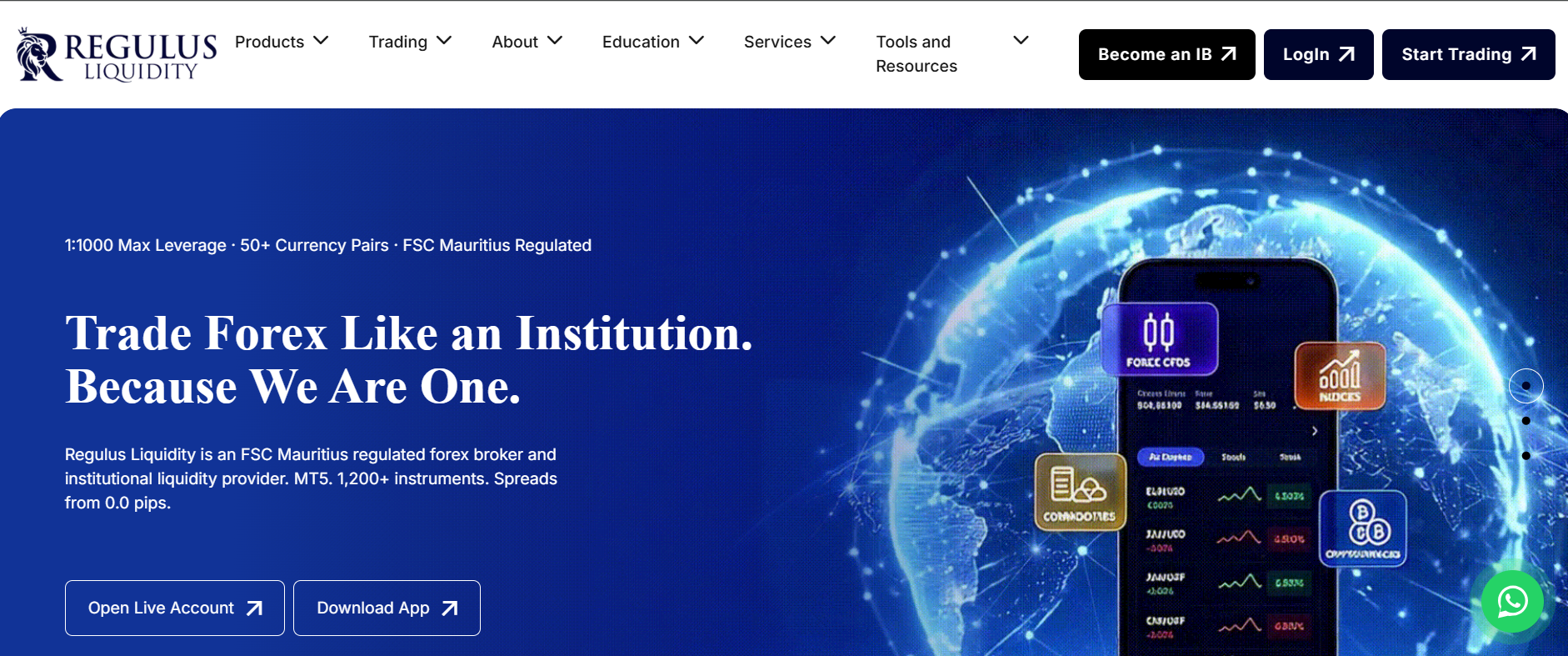
The same can be said about the site’s content. It is overly superficial. At first glance, it appears to address every topic, but everything ultimately revolves around a single message: how fortunate you are to have Regulus Liquidity. For example:
- The homepage serves more as a promotional presentation than an informative introduction. It provides very little concrete information, while every section emphasizes the broker’s supposed advantages.
- The About section contains almost no meaningful information about the company itself. Instead, nearly every page attempts to convince visitors that they should be delighted to trade with this broker. This is particularly noticeable on the Our Charges page. Contrary to what the title suggests, it does not disclose the broker’s actual commissions. Instead, the page repeatedly claims that the fees are low, that the broker charges only what is necessary, and that traders should appreciate how reasonable those charges supposedly are.
- The Deposits/Withdrawal page in the Trading section follows the same pattern. The company promotes the transparency of deposits, the speed of withdrawals, the security of its payment methods, and the clarity of its AML-compliant procedures. Unfortunately, once again, these are merely claims. The broker provides no list of supported payment methods or payment systems, nor does it disclose transfer conditions such as fees, limits, or processing times. Apparently, this information is considered highly confidential and becomes available only after registration — and perhaps after taking a solemn oath never to disclose it.
In short, if a trader wants to obtain any specific information, they have no choice but to register. Fortunately, the process is quick (taking less than a minute) and simple, requiring only a first and last name, an email address, and a phone number. After confirming the email address, users receive full access to the client area and the trading platform. Verification is not required at this stage; it only becomes necessary when submitting the first withdrawal request. In other words, the entire process is organized much like that of a typical offshore broker.
We could not understand why a regulated company would require such secrecy. This approach would seem more appropriate for an unregistered platform with no corporate bank accounts or payment cards, or for a scam project attempting to conceal its financial details from regulators. But Regulus Liquidity is not such a company — or perhaps our suspicions about the unauthorized use of a Mauritian company’s details, or the purchase or leasing of that company, are closer to the truth than they appear.
Is the Broker Offering Fair or Risky Terms for Traders?
People quickly become accustomed to good standards. That is why we expected a regulated broker like Regulus Liquidity to provide detailed information about its trading conditions. Instead, the company limits itself to publishing brief account descriptions with only a handful of basic features.
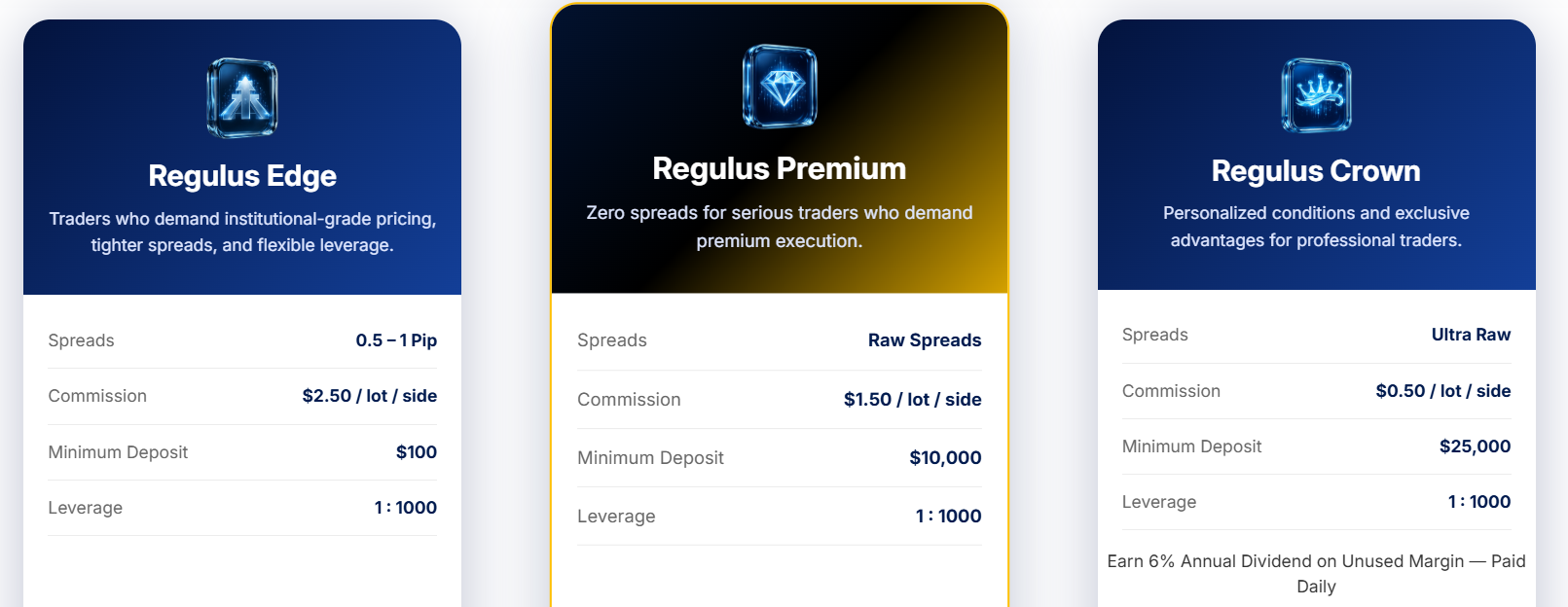
As shown on the website, traders can choose from three account types:
- Edge — Minimum deposit of $100, spreads of 0.5–1.0 pips, and a commission of $2.50 per lot per side ($5.00 per round-turn lot).
- Premium — Narrow spreads (no specific values disclosed) and a commission of $1.50 per lot per side. To qualify for these lower trading costs, clients must deposit at least $10,000.
- Crown — Even lower trading costs, with ultra-tight spreads (again, without any actual figures) and a commission reduced to $0.50 per lot per side. Access to this account requires a minimum deposit of $25,000.
Regulus Liquidity also appears to target traders with little or no trading experience. After all, only inexperienced users are likely to accept trading with a broker that does not disclose its actual spreads, swap rates, or the levels at which Margin Call and Stop Out are triggered. As for beginners attracted by the broker’s supposedly attractive offers, we can only express our sincere sympathy.
Technical Support Analysis of Regulus Liquidity
After browsing through numerous promotional pages on the company’s website that provide little useful information, we did manage to find one exception. The Contact Us page actually contains several ways for traders to get in touch with the company. It includes:
- A contact form.
- A telephone number with a UK country code.
- A customer support email address.
- An office address in the Republic of Mauritius.
The publication of a UK mobile phone number, rather than a Mauritian landline, is quite telling. It reinforces our view that it is unlikely any actual support staff are located in Mauritius and provides yet another argument in favor of our theory that the broker is operating through a purchased or leased company holding an existing license.
It is worth noting that, after examining Regulus Liquidity’s trading offering, we no longer consider the alternative hypothesis — that the broker is simply using another company’s details without authorization — to be the more likely explanation. We confirmed that the broker has obtained software from MetaQuotes and is listed among the official trading servers, something that would not be possible without formal corporate registration.
The website also includes an online chat and several social media profiles. However, the Instagram account could not be accessed. The account on X (formerly Twitter) is available, although it was created only in December 2025 and has attracted just 10 followers in more than half a year. Once again, this supports our conclusion that the project was launched less than a year ago and has not achieved genuine popularity despite an active campaign to build its reputation artificially.
Strengths and Weaknesses
- The broker operates through a company officially registered in Mauritius and licensed by the local FSC regulator.
- Traders can start with a minimum deposit of $100.
- The website resembles a marketing platform more than the informational website of a regulated broker.
- It lacks essential information, including the company’s history, corporate details, Professional Indemnity Insurance coverage, the banks where segregated client accounts are held, and other important disclosures.
- Information about deposits and withdrawals is almost entirely withheld.
- Trading conditions are only partially disclosed. Trading costs appear relatively high, while leverage of 1:1000 exposes traders to excessive levels of risk.
- The project owners appear to be actively promoting the broker online through efforts aimed at artificially creating a positive reputation.
Highlights
Less than 1 year
License from a questionable jurisdiction (FSC of Mauritius № GB23202202)
MetaTrader 5
Up to 1:1000
$100
Medium
Email support/Phone support/Live chat support
Credit/Debit cards/ePayments/Crypto
Fake positive reviews
FAQ
Can a regulated broker really offer leverage of 1:1000?
Why is so much attention paid to trading costs?
Can the FSC of Mauritius help me recover money if the broker refuses to process my withdrawal?
Brokers under discussion



1 review about Regulus Liquidity
Sort by:
-
The people working at this company are unbelievable. First, they tell you about unlimited opportunities, offer assistance, and even help you make a little money. Then they gradually convince you that you need to deposit more and more. Fortunately, I came to my senses before losing everything. After making my first deposit, I traded for a while and then tried to withdraw at least part of my money. That’s when they started telling me I needed to open an insurance account and then pay various unexplained fees. In the end, they kept my money (fortunately it was only USD 300), and I blocked all of their phone numbers. I’m warning everyone!!!!!! Regulus Liquidity is a scam. Stay as far away from it as possible.
We’ve created a glossary to help you understand key concepts. Click the button or follow the link to explore.
