
Savexa Review: Legit Broker or Just Another Scam?


About me
Table of Contents
Today in our Savexa review, we are looking at yet another offshore-licensed broker claiming to be reliable. However, its trading conditions clearly show that the platform’s main goal is to funnel client deposits into the pockets of the project owners. Firms like this are far from rare, and we hope our materials will help market participants, especially beginners, avoid irreversible losses. More details below.
Does Savexa Show Any Risk Factors?
The broker presents itself as a fully legal company, providing services within the law on the basis of an active license. Savexa cites the following as proof:
- Its operations are carried out under the management of Trade Tide Ltd, registered on Mwali (Moheli), Comoros Union, under number HT00324038.
- The company holds brokerage license No. BFX2024065, issued by the local financial authority MISA (Mwali International Services Authority).
Sounds solid enough, at least for beginners. The only question is whether these claims are true.

The regulator’s register confirmed the information published on the broker’s website. Trade Tide Ltd was incorporated on April 1, 2024, and received its license the same day, which has already been extended until 2026. The company indeed operates the broker with the official website savexa.com.
First, a few words about the jurisdiction itself. Mwali (Moheli) is an autonomous island within the Comoros Union. It is a popular African offshore hub with minimal requirements for company registration. For example, there is no need to confirm share capital, no requirement for the actual presence of company owners during registration, and not even a real office address (most get by with just a P.O. box).
At the same time, a MISA license is arguably the cheapest and most accessible on the market. Even the official financial regulator of Comoros, the Banque Centrale des Comores (BCC), has repeatedly stated that MISA is a commercial organization that simply sells licenses without any legal basis. The BCC does not recognize MISA-issued permits for banks or financial services providers. And there are good reasons for this: the self-styled regulator imposes virtually no requirements on brokers — no minimum capital, no participation in compensation funds, no client risk restrictions. It doesn’t even conduct audits or inspections. As a result, such licenses look convincing only to newcomers, while professionals have long regarded them as worthless.
So, the company was incorporated in April 2024, while the savexa.com domain, according to Whois, has existed since 2015. A well-known trick — buying an aged domain to appear as a market veteran.

However, any illusions quickly disappear when checking snapshots from the Web Archive. These show clearly that during 2023–2024 the domain was listed for sale by hosting provider atom.com. A real website appeared only after the last update in late October 2024, with the first full snapshot dated April 2025. In fact, this proves the site has been active for no more than nine months. Naturally, the question arises: which broker was Trade Tide Ltd supposedly managing between April and November 2024? Surely it wasn’t sitting idle for eight months waiting for Savexa’s website to launch. Unfortunately, we were unable to find out. What we can say is that until June 2025 there existed another broker website, tradetide-limited.com, which scammed quite a few clients. Whether it is connected to the current company remains unclear.
Indirect confirmation of Savexa’s founding date comes from reviews online. As of today, Savexa has 52 reviews on Trustpilot, with the earliest ones appearing in January 2025 — which aligns with our assumptions. Most of them are positive (about two-thirds), with 19% neutral and about 15% negative. At first glance, that looks like a normal picture. But a quick look at professional portals like WikiFX makes things clear: experts do not consider the broker trustworthy or safe. In fact, Savexa scored just 1.1 out of 10, with users advised to stay away. And that is probably the more realistic evaluation.

Let’s Break Down the Leverage
So, the offer of maximum leverage of 1:400 is a serious red flag and carries extremely high risks for clients. Such leverage is not permitted by any reputable regulator (for example, in the EU, the maximum leverage is 1:30, and in the US — 1:50).
When trading with 1:400 leverage, even the slightest market move against an open position can result in a complete loss of the deposit. A simple example illustrates this clearly:
If a trader deposits $1,000 and uses leverage of 1:400, they can open positions worth up to $400,000. If the position drops in value by just 0.25%, the losses amount to $1,000 ($400,000 * 0.0025), and the broker will automatically close the trade. This leaves the trader virtually no room for maneuver and no chance to withstand even minor market fluctuations. In practice, the deposit can be wiped out within the first few trades.
What Does the Savexa.com Website Reveal?
It is difficult to find kind words about the design of Savexa’s official website. At first glance, it looks fairly appealing, but… spend 10–15 minutes using it, and you’ll notice how the constant switch between dark and white blocks tires your eyes, while the ever-expanded left sidebar menu can hardly be called a clever design solution (and, frankly, it is just annoying).
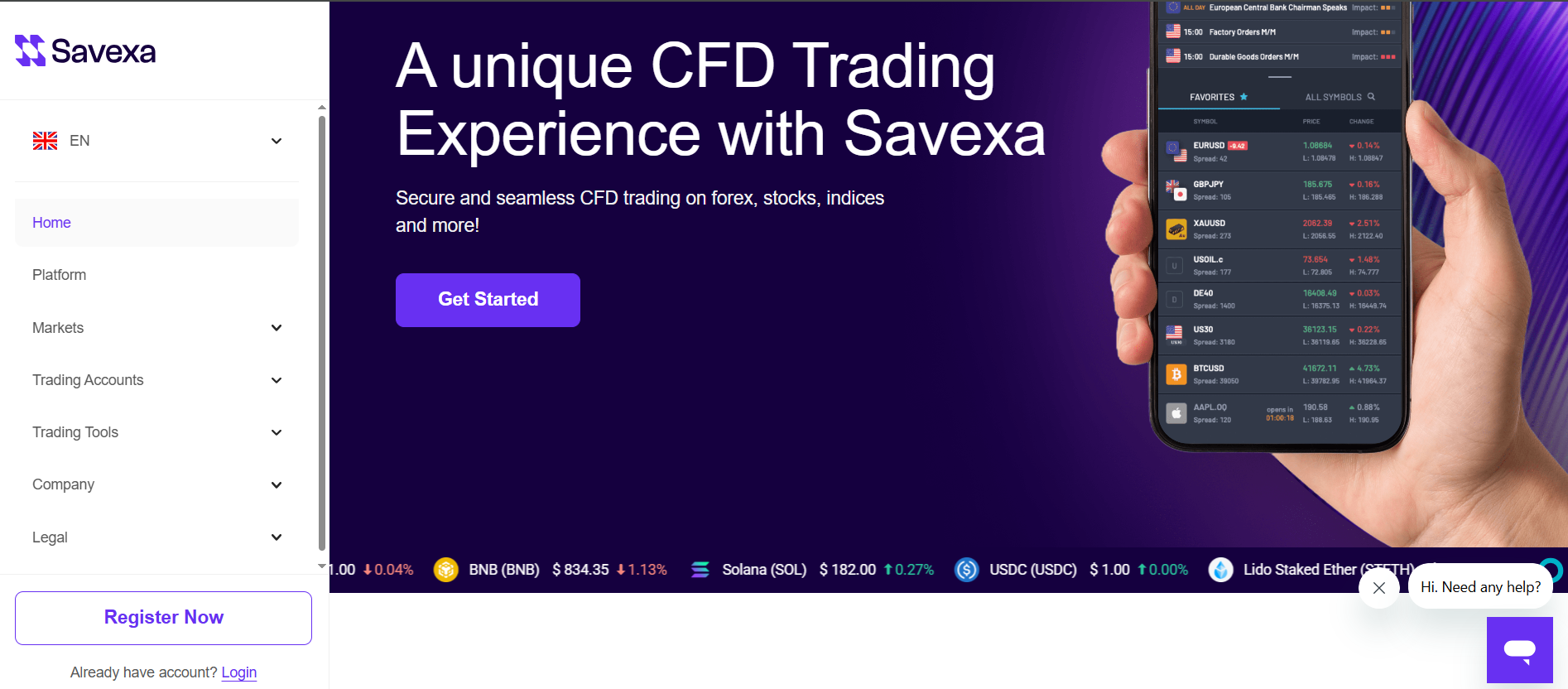
However, the problems with the company’s content are far more serious. For example:
- All pages in the Markets section are structured the same way: a 2–3 sentence description under a pretentious heading like “Understanding [asset class] trading”, followed by a similarly short motivational block telling traders why they should trade in this market at all. Each page ends with a list of assets available at Savexa. In fact, the entire section could be removed — the textual content offers nothing new or useful, and the list of instruments is already available elsewhere.
- The About Us page was likely written by a journalist (or an AI tool), rather than an actual company employee. This conclusion comes from the sheer number of flattering words about the firm, while truly important information is missing (except perhaps the licensing details, which Savexa repeats literally on every page). It is obvious that the content managers either don’t know what potential clients really want to see, or deliberately avoid publishing such information because it would make it clear that this is nothing more than a scam dressed up with a worthless license.
- The lack of concrete details is, in fact, a hallmark of almost all the broker’s pages (with the possible exception of the contact information and trading conditions). And this is not surprising: when the regulator sets no strict requirements, the firm has no incentive to publish meaningful data. For a simple reason — they have nothing to show; otherwise, they wouldn’t have purchased a MISA license in the first place.

Is the Broker Offering Fair or Risky Terms for Traders?
What the company’s staff really put effort into are the trading conditions. If only they were more acceptable in terms of risks and costs, and if the broker actually intended to work honestly, they would be truly worth something.
Officially, Savexa offers five account types: Classic, Silver, Gold, Platinum, and VIP. The trading conditions across all tiers are nearly identical:
- Maximum leverage 1:400.
- List of trading instruments includes 160 CFDs.
- Margin Call level 100%, StopOut 20%.
- Higher-tier accounts supposedly get swap discounts, but no exact figures are provided.

The main differences are in spreads. On the Classic account, they start from 2.5 pips, Silver — also 2.5, Gold — 1.8, Platinum — 1.4, VIP — 0.9. For comparison: with popular regulated brokers, spreads on EURUSD usually remain in the 0.6–0.9 pips range. Here, such conditions are promised only to VIP clients.
By the way, how much one has to pay for access, we do not know. The company does not disclose minimum deposits for each account type. The only amount we managed to find in the FAQ is $250, clearly meant for the Classic account. Given the reputation of this kind of broker, we are quite confident that for Silver (which is not much better in terms of conditions), the minimum deposit will be at least ten times higher.
We said that the broker worked diligently on its trading conditions for a reason. There is a consolidated table of trading instruments, listing them all along with leverage levels for each. This information is also duplicated across the Markets section pages. The company has even published a full swaps table for all assets.
However, the overnight fees are always negative — and quite significant. For example, on EURUSD the swap for a buy position is –47.28 pips, and for a sell — –45.7. This means that just to break even after holding overnight, a Classic account needs at least 7 pips of profit (including spread). The daily range of the pair is usually 20–50 pips, so the costs account for 35–70% of the possible move. On Thursdays, when a triple swap is charged, the required profit jumps to a full 20 pips. And this is without even counting commissions!
Technical Support Analysis of Savexa
Take a look at the company’s contact details. Some people may find them surprising, but this is exactly what we expected.
On its contact page, Savexa lists:
- A feedback form.
- A support email.
- A mobile phone number with a UK dialing code.
On almost every page, the firm repeats its address in Mwali. They are not even embarrassed that dozens of brokers registered there use the exact same address. We know very well that this is not an office but just a mailbox. Looking for a real corporate presence in that offshore jurisdiction is completely pointless. In fact, it doesn’t exist anywhere, as evidenced by the support’s mobile phone. As expected, this scam operation exists only on the internet.
Surprisingly, the firm even has social media profiles. However, visiting those pages gave us a good laugh. For instance, on X (Twitter) the account appeared in January 2025, and in 8 months it has published just one post, attracting the grand total of three followers. On YouTube, things are slightly more active — 8 videos and 44 subscribers. Impressive figures, aren’t they?
Strengths and Weaknesses
- Almost complete information about trading conditions.
- Presence of official registration and a license (albeit offshore).
- The MISA license is not recognized by either experts or regulators and provides virtually no protection for traders.
- Trading conditions with 1:400 leverage, huge spreads, and swaps can hardly be called favorable.
- It is unknown from which countries the company accepts traders.
- The broker has no physical offices; it exists only online.
- Positive comments about the company’s activities are paid for, while experts give it a very low rating.
Highlights
Less than 1 year
License from a questionable jurisdiction (MISA № BFX2024065)
Web platform
Up to 1:400
$250
Average (spreads from 0.9 pt)
Email support/Phone support/Live chat support
Bank cards, Crypto
Fake positive reviews
FAQ
What’s wrong with the MISA license?
Do you think the broker won’t pay me my profit or return my deposit?
Why does the rating on WikiFX differ so much from what we see on Trustpilot? Where’s the truth?
Brokers under discussion



3 reviews about Savexa
Sort by:
-
I checked Savexa’s license, and because of it and the supposedly solid conditions, I immediately opened an account and sent $10,000 there. At first, trading seemed normal, but soon strange problems began. By the way, before that, a manager had called me and suggested adding more funds to the deposit to grow profits faster. I refused, and the very next day the terminal started showing errors, orders were executed with slippage, and “spikes” triggered stop losses. When I began to complain, support stopped responding completely. On top of that, my withdrawal request has been pending for a month with no processing. Looks like these are scammers after all, just well-disguised ones.
-
I funded my Savexa account with $1,000. The first impression wasn’t bad – the website looked nice, and a manager immediately called, offering me “help.” But within a week I realized something was wrong with this “help.” Spreads were huge, and swaps were quickly draining my balance. On top of that, the “specialist’s” advice resulted in not a single profitable trade. I decided to quit this trading and at least withdraw the remaining funds. But not so fast: they demanded fresh documents, then “security” claimed to be checking the request and compliance with laws. In the end – a month of waiting and absolutely nothing. Now I think this broker is a typical scammer: they lure you in with promises, then take every cent!
-
After doing a lot of research and also reading lots and lots of reviews about several brokers I chose to open my first trading account with Savexa that was more close to what i was looking for and to me as a beginner it caters my needs especially their education hub
We’ve created a glossary to help you understand key concepts. Click the button or follow the link to explore.
