
Skyriss Review: Legit Broker or Just Another Scam?


About me
Table of Contents
Once again, we return to brokers that claim to hold offshore licenses and insist they operate within the law when serving clients. Our Skyriss review focuses on yet another company from this category. It claims that traders only need the best trading conditions to succeed and promises additional funds to support margin requirements, lightning-fast order execution without delays, and virtually unlimited opportunities. However, we are convinced that these promises cannot be trusted, and that the only outcome for traders who open accounts on this platform is becoming victims of a scam and losing all of their invested funds. You will find more details about this project below.
Does Skyriss Show Any Risk Factors?
We have encountered many brokers that operate under licenses — sometimes even issued by highly respected regulators — while still functioning like ordinary scam platforms. Identifying such companies is far more difficult than exposing typical fraudulent projects, and the official information they provide must be analyzed with particular care. Nevertheless, we always approach this task very seriously. There was no reason to make an exception for the subject of this review.
In the footer of the website, the creators claim that the project is connected to the following companies:
- Skyriss Securities (Mauritius) Ltd, registered in Mauritius and allegedly operating under license No. GB25204272 issued by the local financial regulator FSC.
- Skyriss Financial Consultancy L.L.C, registered in the UAE and licensed by the Securities and Commodities Authority (SCA) under No. 20200000268. The company is described as an affiliated partner of Skyriss Financial Ltd (Mauritius) and Skyriss Securities Ltd (Saint Lucia).

As for the Mauritius-based legal entity, the information provided by the platform’s creators is also easy to verify. First, let us examine the registration details, since the broker itself chose not to publish them.
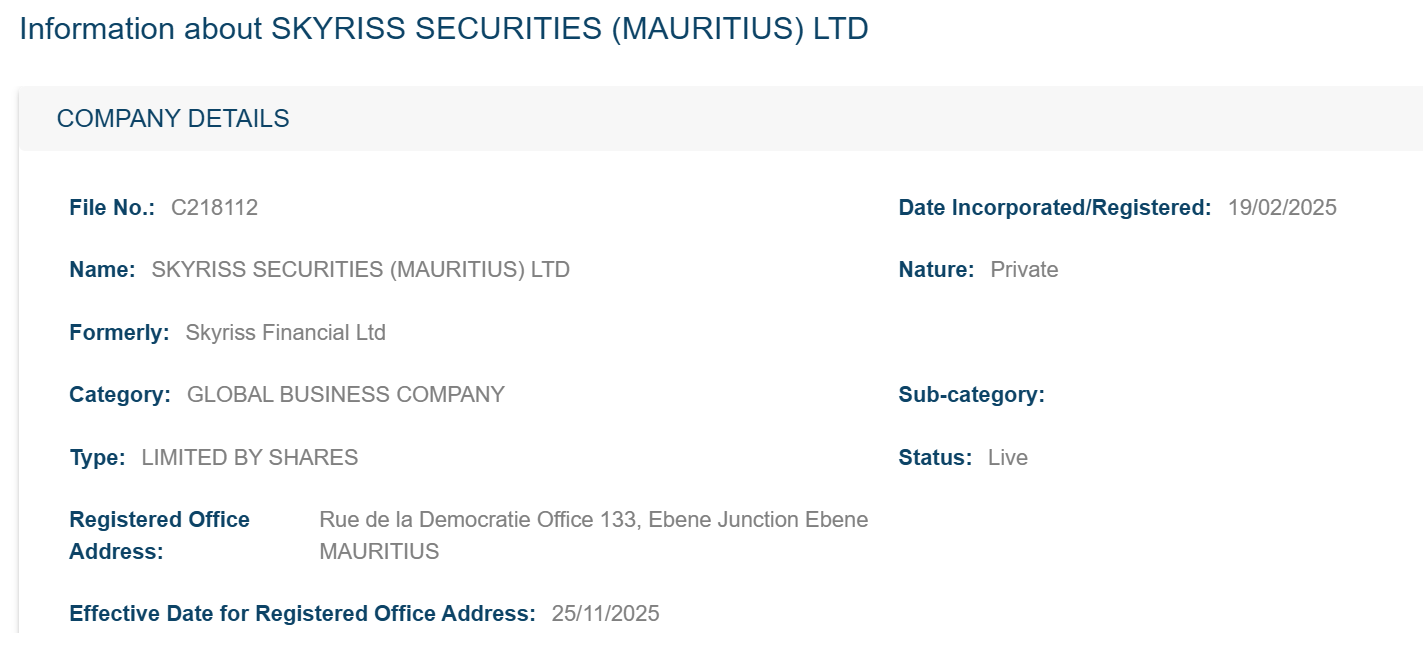
In the Mauritius business registry, we found a record for Skyriss Securities (Mauritius) Ltd. The company was registered on February 19, 2025, under registration number C216112. Interestingly, the company was originally named Skyriss Financial Ltd. before changing its name to the current one. Neither the registry nor the broker’s official website explains why such a change was made within such a short period of time — only around 15 months have passed since registration.
Naturally, we also checked the registry of the Financial Services Commission (FSC) of Mauritius to verify whether the platform actually operates under a valid license. The search result was also positive.
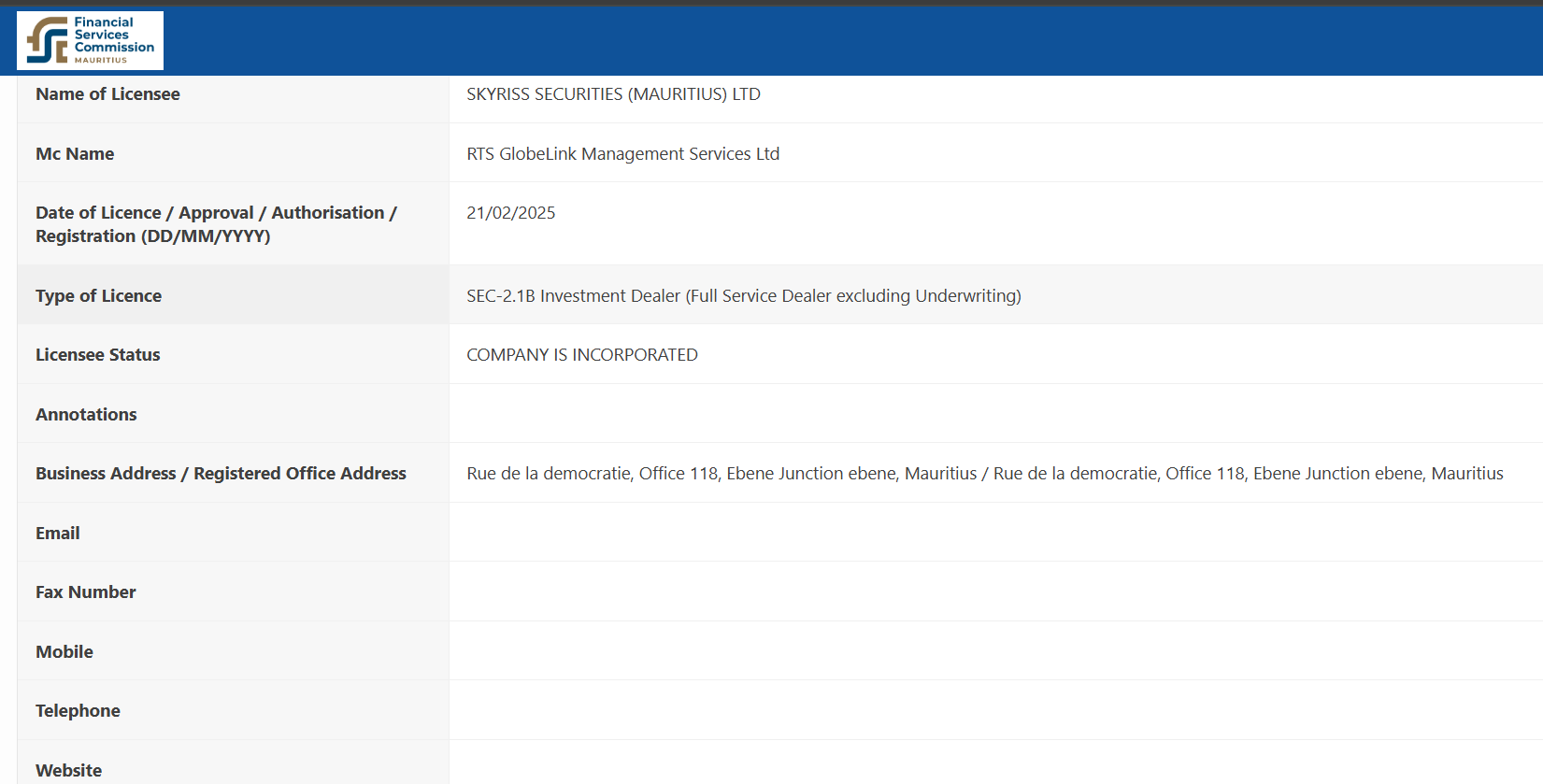
We can see that the company received the document on February 21, 2025 — literally just two days after registration. Unfortunately, the Mauritius regulator’s registry does not provide information about the trading names of the license holder or the websites associated with it. Therefore, we can confidently say that Skyriss Securities (Mauritius) Ltd is engaged in licensed activities, but we cannot confirm that this particular company actually operates the broker. The possibility that the project’s creators simply found information about a suitable company in open sources and are using it for their own purposes cannot be ruled out. Even matching names are far from sufficient proof. Especially considering that this platform has already engaged in similar behavior in the past (more on that below).
The About page also contains several statistical claims regarding the company’s operations. One particularly interesting detail — if it can even be called that — is the attempt to convince visitors that the platform has 26 years of industry experience. Naturally, no evidence is provided to support this claim. We find it extremely difficult to believe, since we have been monitoring both legitimate and questionable brokers for many years and have never encountered the name Skyriss, not even among companies with a five-year history.

If we look at the Whois data, we can see that the active domain skyriss.com was registered on November 28, 2024. This aligns perfectly with the registration and licensing dates of Skyriss Securities (Mauritius) Ltd. However, a domain age of one and a half years is clearly not the same as 26 years in the industry, which means these statistics can safely be classified as another implausible legend.
The same assessment applies to the claim of a community consisting of more than 250,000 professional traders. Perhaps such an audience could have been built over a period of 26 years. But achieving this within only 1.5 years of the domain’s existence would require attracting more than 550 new clients every single day — which in turn would mean generating at least 11,000 daily website visits on average. That is simply unrealistic.

This means that at the very beginning of its existence, Skyriss openly misled clients by presenting another company’s details as its own. Even if the broker is now officially operating under a Mauritius-registered company, this is unlikely to restore its reputation, especially since the platform has repeatedly published misleading information.
We also found another confirmation within just a few minutes that the platform’s actual operating history is nowhere near as long as its representatives claim. On Trustpilot, the first skyriss.com review was posted only one year ago, on May 29, 2025. In practice, this strongly suggests that the broker only began providing services a few weeks before that date — not 25 years earlier.
To be fair, the project’s management has clearly invested effort into building a positive public image. On Trustpilot, for example, 97% of the 89 reviews are positive, while only 2% are negative. A similar situation can be seen on WikiFX, although the share of negative comments there is slightly higher — 3 out of 34.
Let’s Break Down the Jurisdiction
Skyriss presents its official registration in Mauritius and its license from the local regulator as one of its key advantages. But is this really the case?
Mauritius is considered an offshore jurisdiction and is one of the preferred locations for many Forex/CFD brokers. The main reason for its popularity is that it is not included on the blacklists of the EU or the OECD (Organisation for Economic Co-operation and Development). As a result, banks and other financial institutions do not impose the same restrictions on Mauritius-registered companies that they apply to entities from jurisdictions such as Vanuatu or the Seychelles.
For brokers, Mauritius is indeed an attractive choice because:
- Capital requirements are relatively low. For example, an Investment Dealer is required to maintain capital of only 1 million Mauritian rupees (MUR), which is approximately $21,000.
- The tax regime is extremely favorable. Companies pay corporate tax at a rate of only 3%. Moreover, when registered as an IBC and generating income outside the country, legal entities may even be exempt from paying it.
- The geographical location is highly convenient. One of the key advantages is the time zone, which allows clients from both Europe and Asia to trade comfortably.
At the same time, many experts consider the Financial Services Commission (FSC) of Mauritius to be one of the strongest regulators among those classified as Tier-2. This reputation is based on the relatively strict licensing requirements, including:
- Mandatory local presence: companies must maintain a physical office in the country, while directors or shareholders must include Mauritius residents.
- Strict AML/KYC compliance requirements.
- Regular submission of financial reports.
- Mandatory segregation of client funds.
However, brokers operating under Mauritius regulation are still granted a remarkable level of freedom in their relationships with traders:
- The maximum leverage is determined entirely by the broker, as the regulator imposes no restrictions.
- Bonus programs are fully permitted, and there are no limits on bonus sizes or the conditions attached to receiving and clearing them.
- Brokers are not required to participate in compensation schemes, since no such government-backed program exists in the country, nor are they obligated to maintain liability insurance.
What Does the Skyriss.com Website Reveal?
We believe many users would describe the broker’s official website design as successful. The developers clearly made an effort to present information in a bright, accessible, and logically structured way, dividing the pages into several well-organized sections. Overall, the presentation is easy for most visitors to understand.
The impression is slightly undermined by issues with font sizes in certain text fragments, although this is not a particularly serious problem. Still, while giving credit to the team for the visual presentation, we must point out that this style of information delivery does very little to provide answers to the most important questions traders actually have.
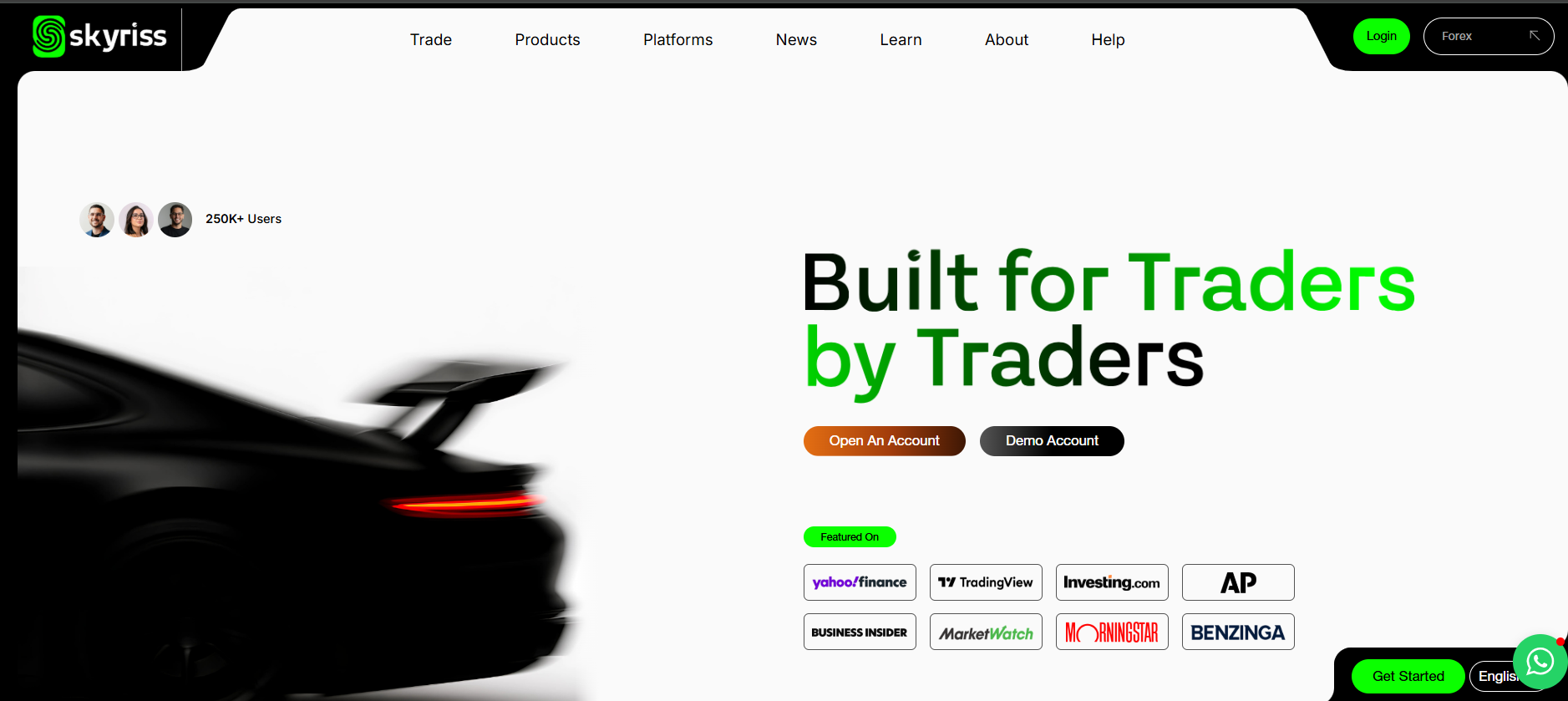
To support this conclusion, let us provide several examples showing that the content on the Skyriss website loses to its design by an overwhelming margin:
- On the pages of the Markets section, the developers attempted to provide brief information about each available market. To put it mildly, we expected much more. We expected to see more detailed explanations regarding the characteristics of different asset groups — for example, seasonality, liquidity, volatility, and similar factors. In addition, it would have been useful to see a complete list of trading instruments along with contract specifications. Instead, visitors are presented with tables showing the current market situation, which offer very little practical value.
- We have already mentioned the About Us page. The most valuable information there could have been the statistical data — if only the company had bothered to provide accurate figures. Otherwise, the page is certainly not overloaded with information that actually matters to traders: there is no detailed company history, no introduction to the team, no financial performance data, and no discussion of achievements. Instead, the focus is placed on several short texts describing how wonderful it is to trade with Skyriss, with a total length of barely a couple dozen sentences. Their informational value, if not negative, is certainly very close to zero.
- Among the official documents published by Skyriss, one can find almost everything — even a policy regarding scalpers. However, the collection is missing several of the most important documents that have long become standard for brokers regardless of which regulator oversees them. We are referring to the KYC and AML policies. Our experience shows that only scam platforms allow themselves to neglect such essential documentation.
By the way, the problems are not limited to the website content alone. Take a look at the new client registration process. The form is extremely basic, requiring only a full name and contact details. The provided link allows users to review only a single document — the User Agreement — while all other materials, including the Risk Disclosure and Privacy Policy, must apparently be searched for manually.
It is impossible to log into the personal account area without email verification. To complete the procedure, the user must follow a link sent to the email address specified during registration. What is particularly noteworthy is that the message also contains the login credentials and password for authorization. In other words, Skyriss appears to know absolutely nothing about basic security practices.
On the other hand, immediately after confirming the email address, users are given the opportunity to deposit funds into the project’s internal wallet. To create a trading account and start trading, verification is required, including the submission of additional personal information and copies of identification documents. At first glance, this may seem normal — until one remembers the complete absence of a KYC Policy. On what legal basis the broker demands disclosure of sensitive personal information and document copies remains entirely unclear.
There are also serious issues with financial operations. The Account Funding and Withdrawal page lists several popular payment methods. However, inside the personal account area, users will only find USDT transfers and bank card payments. Moreover, card payments are processed through an intermediary payment system that does not disclose the recipient’s details.
This approach directly violates AML principles. Yes, it clearly does — but what could possibly stop the project owners from ignoring such requirements if they could not even bother drafting the corresponding policy in the first place?
The extremely limited list of available payment methods looks especially suspicious when compared to the text of the Deposit and Withdrawals Policy. The document states that withdrawals of profits or amounts exceeding the original deposit are preferably processed via bank transfer. However, as already mentioned, Skyriss does not actually support such transactions. One can only speculate whether this inconsistency appeared accidentally due to the use of a template document or whether it was included intentionally.
Is the Broker Offering Fair or Risky Terms for Traders?
We have already mentioned that Skyriss does not publish detailed trading conditions. At the very least, you will not find any proper contract specifications on the website. Moreover, even the account descriptions themselves contain very little useful information about trading parameters.
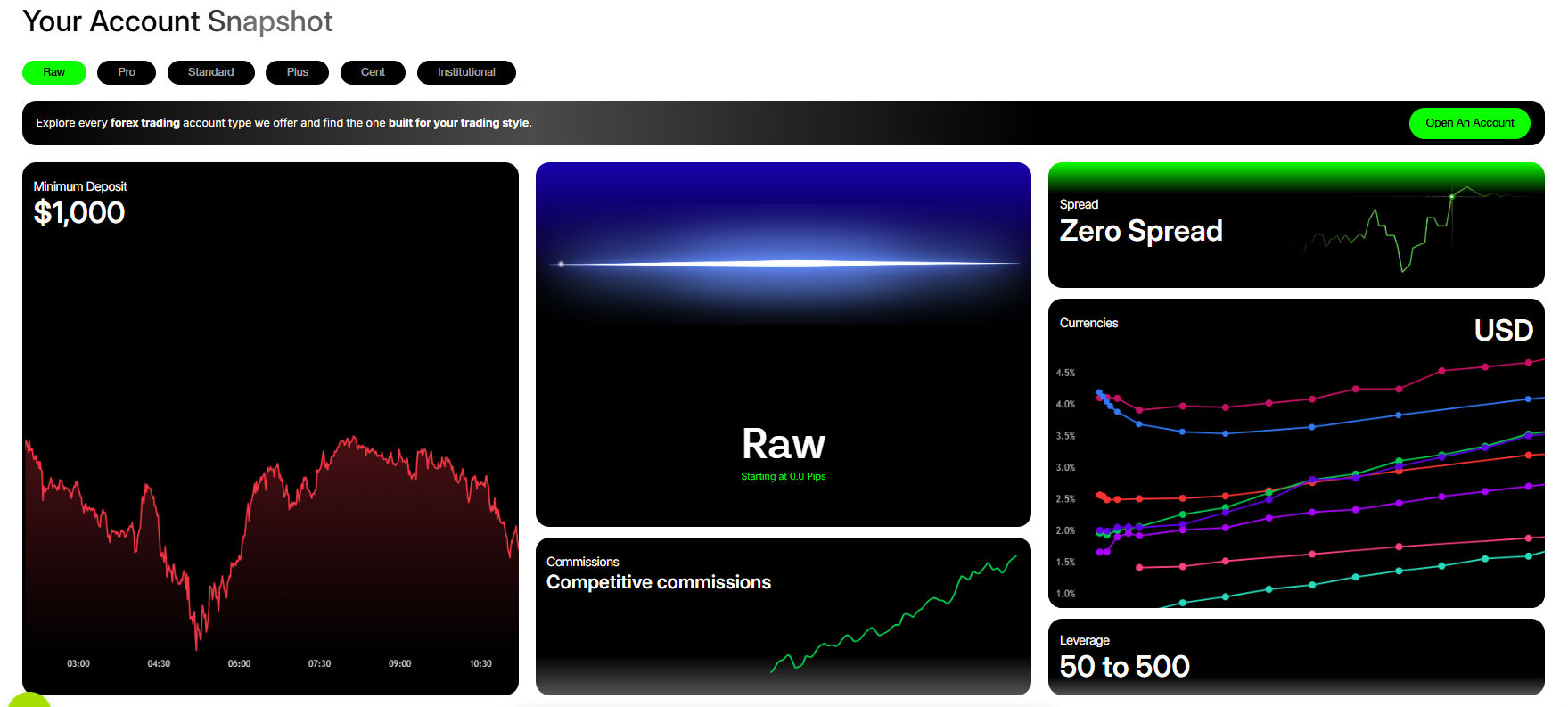
The platform’s staff follow the same familiar pattern here as well: they describe six account types while revealing only the bare minimum of information. The list includes:
- Raw — minimum deposit starting from $1,000, zero spreads, and “competitive” commissions, according to the broker itself. Naturally, nobody bothered to explain what commission size actually falls under this definition.
- Pro — requires a deposit starting from $10, offers zero trading commissions, and spreads of 20 cents. Admittedly, we were rather surprised to see such a minimum deposit requirement for a supposedly professional account.
- Standard — minimum deposit of $100, spreads of 25 cents, no trading commissions.
- Plus — yet another account with a minimum deposit of only $10 and no trading commissions. Spreads are listed as 30 cents.
- Cent — judging by the name, this is a cent-based account. The minimum deposit is 10 USD, commissions are zero, and spreads are described as “tight” — at least according to the broker.
- Institutional — an account intended for large investors capable of depositing at least $10,000 as an initial balance. Spreads are described as “tight,” while commissions are once again called “competitive.”
The published spread values deserve special attention. Spreads of 20, 25, or 30 cents are, in our opinion, nothing short of a masterpiece. Unfortunately, once again the broker forgot to clarify what exactly these figures mean. Since we understand how market quotes are structured, we can reasonably assume that the broker is referring to 2,000, 2,500, or 3,000 points — which raises enormous doubts about the claims of “tight spreads.” If, on the other hand, these numbers represent a fixed monetary amount paid by the trader, then an entirely logical question arises: for what trade volume?
Apparently, the project’s staff at least attempted to provide some clarification. On the pages of the Products section and on the Trade – Fees and Charges page, they published tables displaying current market conditions, claiming that users could see live spread values there. After reviewing this, we fully understood the level of competence demonstrated by the Skyriss team.
The issue is simple: the standard TradingView widgets used in those tables do not display Bid and Ask prices — the difference between which actually forms the spread. During the platform’s entire existence, apparently not a single employee noticed this detail. That alone says quite a lot about the professional qualifications of the people behind the project.
Technical Support Analysis of Skyriss
We also wanted to say a few words about the broker’s support service and its communication with clients. On the contact page, users can find:
- A feedback form.
- The support service email address.
- An office address in Mauritius.
It is rather strange that the company does not provide a phone number. This immediately raises doubts about whether the office address is even real, since it is difficult to imagine office premises operating without landline phone connections. Some may argue that the broker compensates for this by offering an online chat on the website. That is certainly convenient, but in practice we know perfectly well that issues are resolved almost ten times faster over the phone than through chat conversations, even if operators respond instantly.
What Skyriss did manage to surprise us with was the large number of social media profiles. Most of them have been active since early 2025 — meaning they appeared roughly a year after the project’s launch. Meanwhile, a quick review of these pages leaves a rather depressing impression. For example, the YouTube channel consists almost entirely of compilations of economic news, crudely generated using AI tools. Another example is the company’s X (Twitter) account, where virtually every post is nothing more than advertising content linking back to the homepage of the official website. Is any of this actually worth attention? In our opinion, clearly not — but apparently the company simply lacks employees capable of producing more meaningful content.
Strengths and Weaknesses
- Verified information regarding the broker’s official registration and the existence of a license held by the company managing the platform.
- A low entry threshold of just $10, accessible to almost anyone.
- Illegal use of another company’s information during the early stages of the project.
- Publication of false claims regarding the broker’s years of operation.
- Poorly informative website content.
- Insufficient disclosure of trading conditions.
- Purchased positive reviews across the internet.
Highlights
2+ years
License from a questionable jurisdiction (FSC of Mauritius № GB25204272)
Web platform
Up to 1:500
$10
Unknown
Email support/Live chat support
Bank cards, Crypto
Fake positive reviews
FAQ
Why do you consider the absence of trading conditions on the official website a sign of fraud?
Can regulators add the broker’s website to a blacklist?
I already sent money to Skyriss. How can I get it back?
Brokers under discussion



2 reviews about Skyriss
Sort by:
-
The service here is absolutely awful, let me tell you. I’ll have to change brokers because not everyone can tolerate the constant problems with Skyriss. They do not even bother maintaining their equipment properly, that’s one thing. Support either ignores your requests completely or behaves rudely while giving vague and incomprehensible answers, that’s another. And the cherry on top is the broker’s actions that ultimately lead to the total loss of your deposit. I started with 2,000 dollars, and now my balance is rapidly heading toward zero. That’s the third problem!
-
Just a week ago, I deeply regretted getting involved with Skyriss. Unfortunately, the company has absolutely no intention of fulfilling its promises once it receives your money. From my 1,800-dollar deposit, they immediately took almost half, supposedly for some kind of insurance, but I know perfectly well they simply put the money into their own pockets. The remaining funds are still sitting in the account. I do not know how to trade, nobody provides the promised assistance, and I cannot withdraw the money either because my request is simply being ignored.
We’ve created a glossary to help you understand key concepts. Click the button or follow the link to explore.
