
VFM Brokers Review: Legit Broker or Just Another Scam?


About me
Table of Contents
In our VFM Brokers review, we take a closer look at a broker that has supposedly been operating in the Forex/CFD market for quite some time. The trading conditions presented on the website look rather attractive: clients are promised a 100% bonus on their first and every subsequent deposit, professional support, and quality educational materials. However, these are exactly the kinds of promises we hear from countless scam projects. We set out to determine whether traders were once again being lured into a fraudulent scheme. Here’s what we found.
Does VFM Brokers Show Any Risk Factors?
We should say right away that our introduction to this broker was, to put it mildly, unusual. As always, we started by examining the most important official information about the company: its place and date of registration, licensing, regulatory history, and reputation online. At first glance, everything seemed fairly straightforward, but our vfmbrokers.com review quickly changed that impression.
So, what did we find on the broker’s website? According to the information published on its About Us page, VFM Brokers is a brand name owned by Venture Financial Markets Ltd, registered in Saint Vincent and the Grenadines under No. 25874 BC 2020. The same company operates the vfmbrokers.com website.
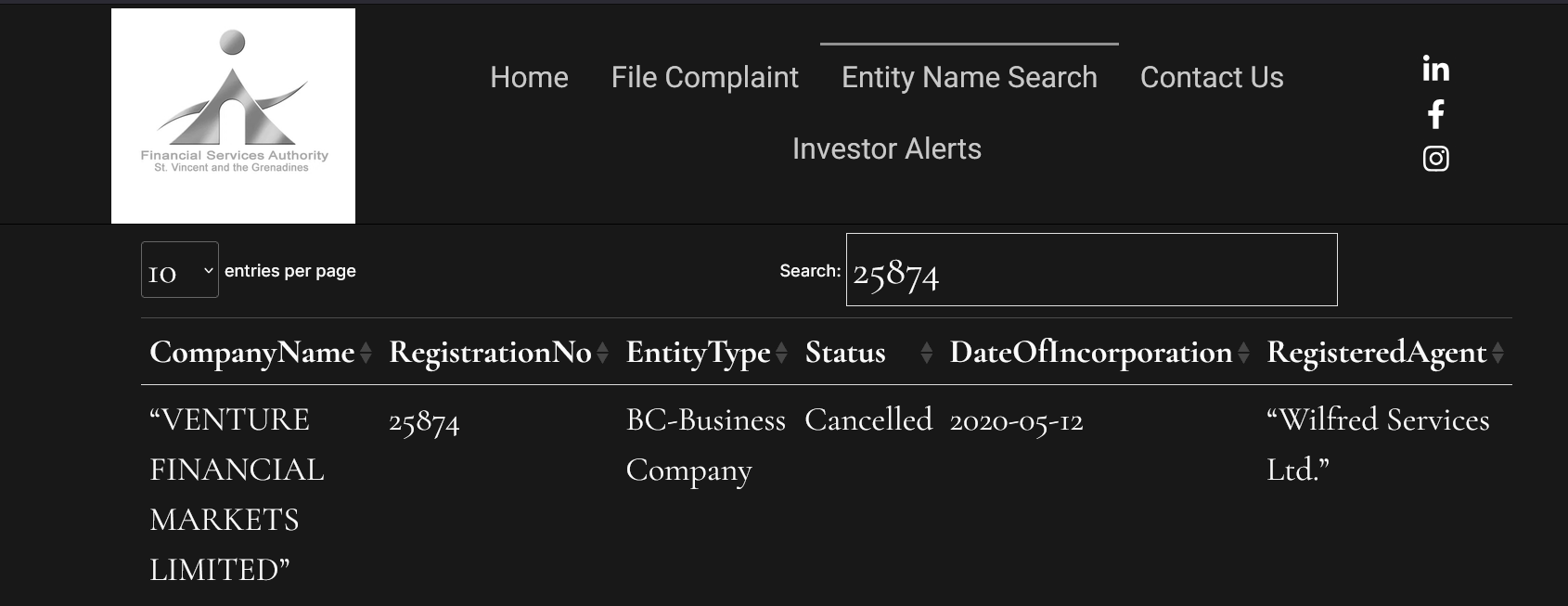
A search of the local regulator’s registry confirmed this information. The Saint Vincent and the Grenadines Financial Services Authority (SVGFSA), which is responsible for registering financial businesses operating in the jurisdiction, shows that the company was indeed registered on May 12, 2020, as a Business Company, one of the corporate structures commonly used by offshore businesses. The registration appears under No. 25874.
In 2020, this might have looked fairly solid to an inexperienced trader: the company was legally registered, and registration in Saint Vincent and the Grenadines was sometimes mistakenly perceived as equivalent to having a broker license. In reality, however, the local regulator did not regulate or license Forex brokerage activities at the time. It imposed virtually no meaningful restrictions on brokers, such as limits on leverage or bonuses, and the requirements were largely limited to properly paying registration and renewal fees.

There have been some changes since then, particularly in the requirements imposed by the SVGFSA. Today, companies whose constitutional documents include brokerage or dealing activities are required to provide evidence of a valid license issued by a regulator in the jurisdiction where they intend to conduct those activities. These requirements were established by Circular No. 1 of 2023 and apply not only to newly registered companies but also to existing entities. Existing firms were required to provide a certified copy of such authorization from the relevant foreign regulator by the end of the transitional period in May 2023.

This finding seriously undermines confidence in the company and its reputation. Operating a brokerage business without the necessary authorization creates substantial risks for clients, particularly because they cannot rely on the safeguards normally associated with regulated brokers. For anyone looking to trade rather than expose their funds to unnecessary risks, opening and funding an account with such a broker deserves extreme caution.
We could end our vfmbrokers.com review here, but we decided to examine the broker’s history as well. And this is where we encountered a major surprise.
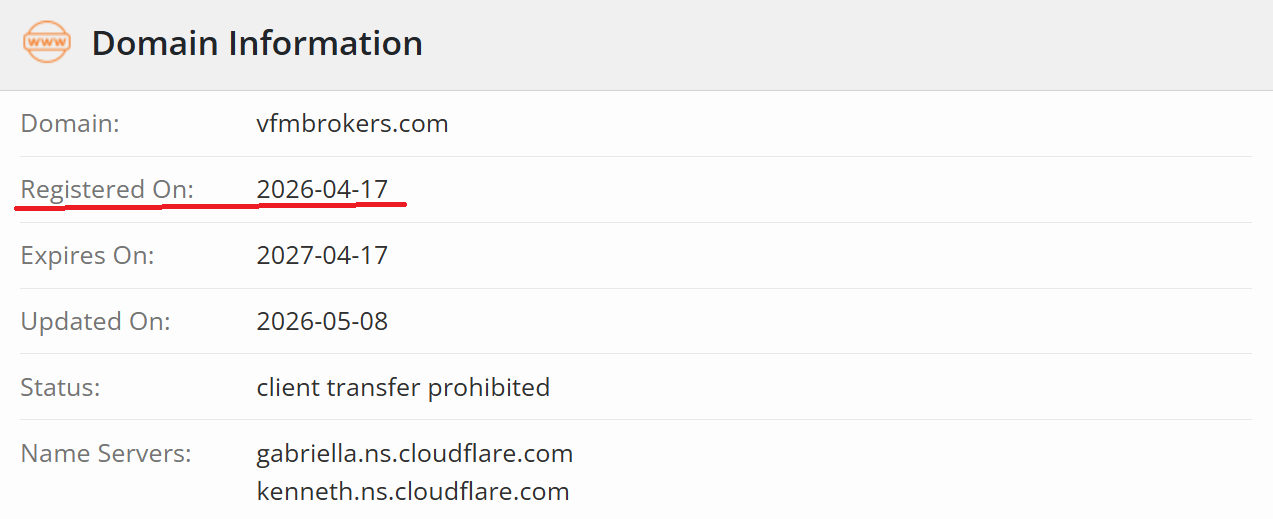
As we can see, WHOIS data shows that the vfmbrokers.com domain was registered on April 17, 2026 — just four months ago. But how, then, could a company established in 2020 have been operating through this domain? Did it really spend six years simply waiting for the right moment to start serving traders?
As it turns out, it did not. Snapshots from the Wayback Machine indicate that a fully developed broker website was previously hosted on this domain and that the platform was actively operating until 2023. This is also supported by numerous reviews on various portals, including WikiFX and MyFxBook, with publication dates ranging from 2020 to 2023. Interestingly, VFM Brokers is currently listed among the Closed Brokers on MyFxBook. In other words, the evidence suggests that the platform operated for some time and then ceased its activities.
So what does the new domain registration date mean? Most likely, it indicates that the domain was purchased again in April 2026 as part of an attempt to revive a project that already had a history online. What is particularly noteworthy is that the new owners — or perhaps the previous owners attempting to bring the company back — apparently changed almost nothing: neither the company’s registration and licensing information nor the website’s design or content. There is, however, one new detail. The footer of some pages now mentions an entity supposedly registered with the U.S. National Futures Association (NFA) under ID 0552020, which was not present on the old version of the website.
We suspect this may be an attempt to create the impression that VFM Brokers complies with the requirements applicable to its Saint Vincent and the Grenadines registration. Apparently, the people behind the project believe that mentioning a document supposedly associated with a U.S. regulator is enough to reassure potential clients.
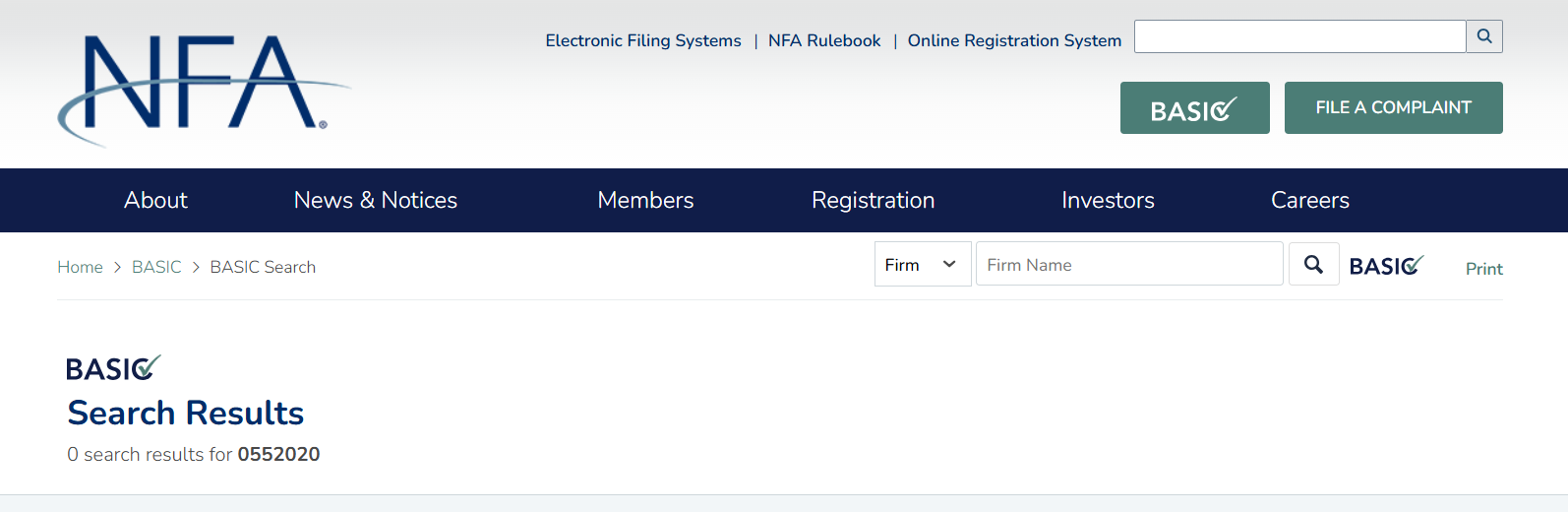
Thus, the new — or perhaps returning — owners of the project appear to have chosen the cheapest possible approach: present traders with a story about having regulatory credentials in another jurisdiction without actually obtaining the corresponding authorization. Such tactics are unfortunately familiar in the world of questionable brokerage projects, but they certainly do nothing to make the revived VFM Brokers more legitimate.
Let’s Break Down the Leverage
We have started outlining the risk factors associated with trading with VFM Brokers. At present, the most significant one is the lack of proper licensing and the apparent provision of brokerage services without the required authorization. However, it is possible that this issue could eventually be addressed following the platform’s relaunch. Unfortunately, it is not the only concern associated with the project.
On the homepage, we see advertising for trading with extremely high leverage of up to 1:1000. The account table presents a somewhat more conservative figure, with a maximum of 1:400. It is worth noting that we cannot yet determine which information belongs to the old website and which has already been updated, so it is too early to say exactly what conditions traders will ultimately receive. Nevertheless, both figures are exceptionally high.
Rather than repeating the usual calculation showing how many points the market would need to move against a position to wipe out a deposit under different leverage levels, let’s look at the approach taken by major regulators. European regulators, as well as the UK’s FCA and Australia’s ASIC, limit leverage for retail investors to around 1:30. Even with these restrictions, a very large proportion of retail traders lose money when trading CFDs.
Now compare that with the leverage offered by VFM Brokers. Depending on which figure is ultimately applicable, it is approximately 13 to 33 times higher than the limits imposed by Tier 1-regulated brokers. What does this mean? Naturally, it creates the possibility of much larger returns on individual trades, which is exactly what questionable brokerage projects often emphasize in their marketing. Such offers can be particularly attractive to inexperienced traders who have limited knowledge of market risks, risk-management principles, and how to apply them in real trading strategies.
Who can benefit most from this arrangement? Naturally, the company operating the trading platform may benefit from higher trading activity and client losses. In many brokerage models, even when a company describes its execution technology as NDD, STP, or ECN, it may still act as a counterparty to at least some client transactions. In such cases, a trader’s loss can become the broker’s revenue.
For an honest broker, this already creates a potential conflict of interest that clients should understand. In the case of an outright scam, the situation can be even more serious: funds deposited by clients may simply be misappropriated, while simulated trading activity and apparent losses can create the appearance that the money was lost through normal market operations.
What Does the Vfmbrokers.com Website Reveal?
The broker’s website, originally created at the beginning of the decade, follows the design traditions of the time, when platforms tried to showcase all their advantages to every visitor. In our view, the pages still look quite decent and demonstrate a thoughtful approach to the choice of color scheme, font sizes and styles, and thematic imagery. However, the new owners should clearly pay more attention to the content. The homepage may work well as a promotional presentation, but, like most traders, we would prefer to see more useful and detailed information.
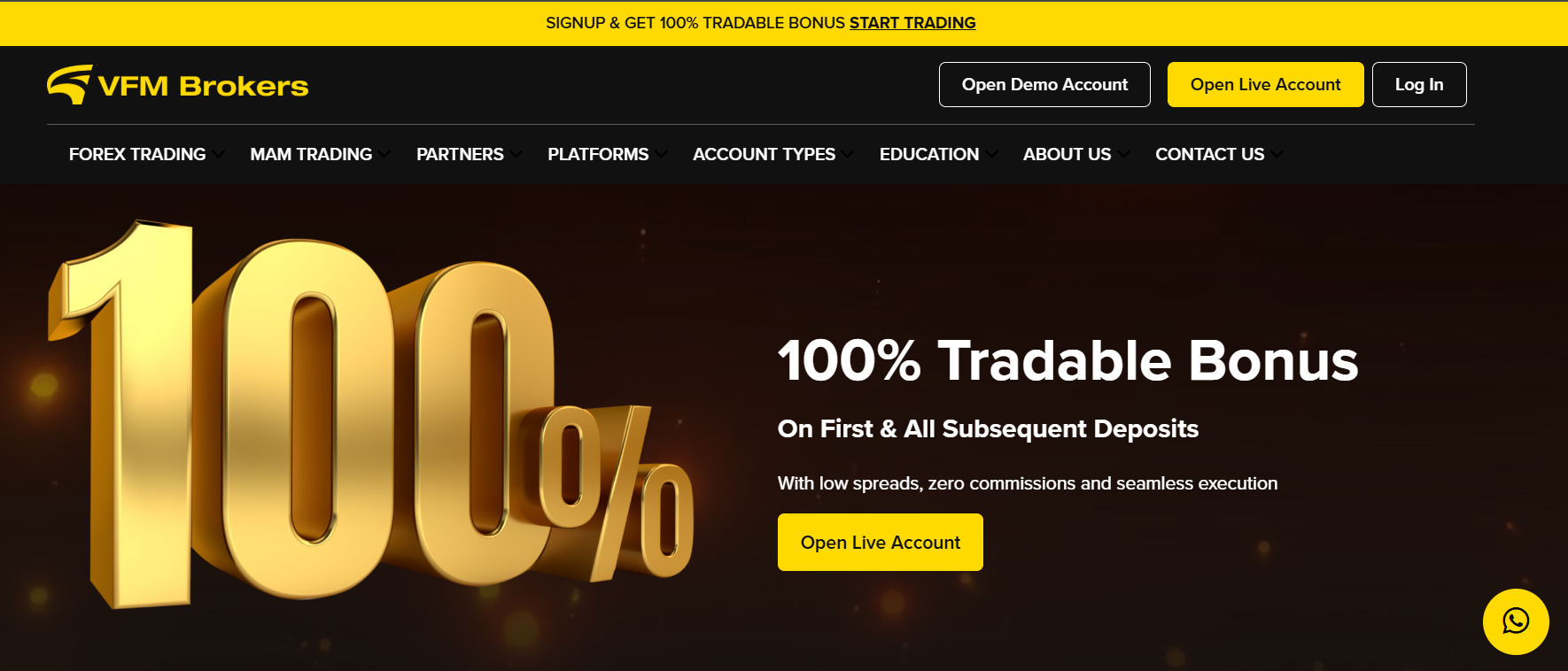
Content is currently the most serious weakness of this web service. In particular:
- The About page, which we mentioned earlier, contains very little useful information. Yes, it includes a section describing the company’s registration and claiming that it complies with industry regulatory standards. However, in our view, this is far from enough for a proper introduction to the company. To strengthen its reputation, the platform could provide at least some information about its history, management team and plans, payment details, financial statements, etc. It would also be a good idea either to remove the empty slider featuring liquidity providers, which currently creates a rather poor impression, or actually populate it with relevant information.
- There could also be much more information about the available markets and trading instruments. The Forex Trading menu contains a dedicated subsection with seven links, but all of them lead to the same page, where descriptions of each asset group are limited to just a couple of sentences. Brevity may be the soul of wit, but traders are unlikely to appreciate such a limited presentation, and its practical value is minimal.
- The Blog section is even more problematic. The latest publications date back to 2022, apparently from the previous period of the website’s existence. We could understand why the new owners have not yet updated everything, but four months have already passed since the domain was registered again and, presumably, the website was acquired. In our opinion, that is more than enough time to bring the pages up to date.
We could continue listing everything that needs to be restored after VFM Brokers’ long period of inactivity. Instead, we will focus on two particularly important issues:
- All links to the broker’s legal documents are broken. None of them opens, including the Terms & Conditions and Privacy Policy. This may not be critical if the relaunched platform is not yet accepting new clients. If it is already operating, however, this is a major Red Flag, because potential clients have no access to the legal documents governing their accounts, deposits, and trading activities.
- The registration form does not work either. Users can fill in the fields, but the information cannot actually be submitted. After four months, one would expect the company to have established a functioning connection between the registration form and the client area. Alternatively, it raises the question of whether the owners are currently onboarding clients through other channels, such as direct communication with prospects whose contact details may have been obtained through questionable or unauthorized means.
Is the Broker Offering Fair or Risky Terms for Traders?
The broker does not publish detailed trading conditions. The Markets page in the Forex Trading section contains no contract specifications, leaving users without a significant portion of the information needed to properly assess VFM Brokers’ trading offers. Essentially, everything the company is willing to disclose is presented on the account-type pages.
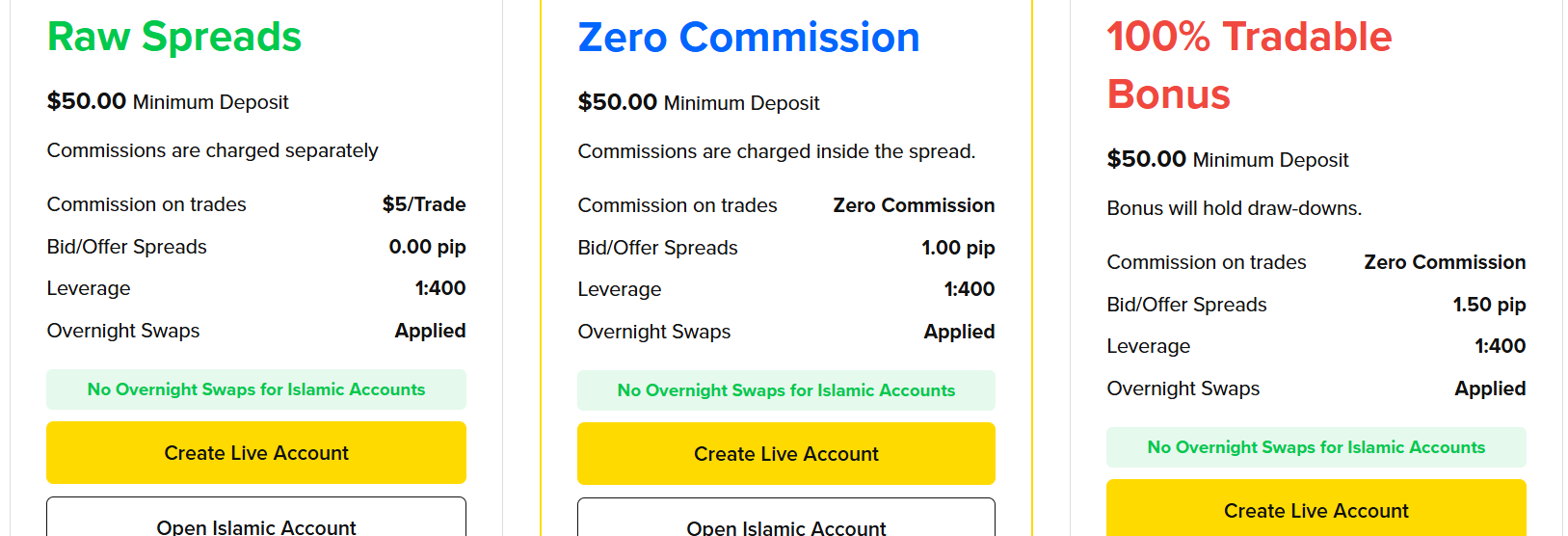
As we can see, the broker currently offers three main account types:
- Raw Spreads.
- Zero Commission.
- 100% Tradable Bonus.
The second and third accounts are almost identical. The main differences are the spread sizes — from 1.0 pip on Zero Commission and from 1.5 pips on 100% Tradable Bonus — and the availability of the bonus that gives the third account its name.
There are also relatively few differences between these accounts and Raw Spreads. The main ones concern spreads and trading commissions. The second and third accounts have no trading commissions but relatively wide spreads starting from 1.0 or 1.5 pips. Raw Spreads, on the other hand, offers zero spreads with a commission of $5 per lot per trade. This appears to refer to one side of the transaction, meaning the full round-trip commission would amount to $10 per lot. In terms of total trading costs, this is roughly equivalent to a 1-pip spread.
The remaining conditions are the same across all three accounts:
- Maximum leverage: 1:400, according to the account table.
- Minimum deposit: $50.
- Minimum trade size: 0.01 lot.
- Maximum position size: 100 lots.
- Maximum number of open positions and pending orders: 200.
- Islamic, swap-free accounts: available for each account type.
There are still several important points worth noting:
- Extremely high leverage. From a risk-management perspective, there is relatively little practical difference between leverage of 1:400 and 1:1000: both create a very high level of exposure for retail traders. We have already discussed this issue above.
- No information about swaps. Without swap rates, clients cannot accurately calculate the full cost of holding positions overnight or determine whether the advertised trading conditions are actually competitive.
- Spreads are not particularly tight. Spreads starting from 1.0 or 1.5 pips are around two to three times wider than those available from many modern regulated brokers.
- Margin Call/Stop Out levels are not disclosed. This makes it difficult for traders to understand the exact rules governing forced position closures and to build an accurate risk-management strategy.
Technical Support Analysis of VFM Brokers
The company’s contact information also leaves some room for improvement. While there is a dedicated contact page, the actual ways for traders to reach the company are quite limited. In practice, users can mainly rely on the contact form. The registered address in Saint Vincent and the Grenadines is a virtual address, while the website does not provide a telephone number or even a support email address. The live chat function is also unavailable.
Strengths and Weaknesses
- The broker uses the details of an existed company and a previously operational official website.
- A minimum deposit of $50 makes the platform accessible to traders with relatively limited starting capital.
- The broker did not hold a license, as the SVGFSA does not regulate or license this type of brokerage activity.
- The current operation of the platform appears to be outside of any jurisdiction.
- Although the inherited website still looks reasonably professional, much of its content does not correspond to the current state of the project.
- The trading conditions are not particularly competitive and involve significant risks.
- There are currently no reviews of the relaunched version of the project online.
Highlights
Less than 1 year
No license
MetaTrader 4
Up to 1:400 or 1:1000
$50
Medium
–
Unknown
No reviews
FAQ
Is it realistic to make money with this broker?
Is it safe to fund an account with this broker?
Can the broker guarantee profitable trading?
Brokers under discussion



1 review about VFM Brokers
Sort by:
-
I honestly don’t understand how anyone can consider an offshore broker without a clear regulatory license and with leverage of either 1:400 or 1:1000 a particularly safe choice. Such leverage can cause a substantial portion of a deposit to disappear very quickly, especially for inexperienced traders. And if there were ever a dispute over pricing or execution, clients might face difficulties challenging the broker’s actions because of its offshore structure and limited regulatory oversight. I simply don’t see enough evidence yet to trust the relaunch of VFM Brokers, especially when it appears to be targeting less experienced traders.
We’ve created a glossary to help you understand key concepts. Click the button or follow the link to explore.
